P3: Risk Management develops advanced skills in identifying, assessing, managing, and responding to financial and business risks to support effective strategic decision-making.
First, identify what could prevent a business from meeting its goal. Then assess the likely effect and compare suitable responses. For example, a supplier delay may affect sales, cash and customer trust. Therefore, explain the links between risks before recommending an action.
| Sessions | Course focus | Practice purpose |
|---|---|---|
| 1–3 | Enterprise, strategic and operational risk | Identify risks in the business context |
| 4–6 | Assessment, financial risk and responses | Compare impacts and possible actions |
| 7–8 | Controls, governance and emerging risks | Assess oversight and the control environment |
| 9–10 | Integrated analysis and revision | Apply P3 knowledge to case questions |
The Chartered Institute of Management Accountants (CIMA)
The CIMA was founded in 1919. The CIMA head office is located in London, UK.
In 2017, AICPA & CIMA came together to forge a powerful international alliance that promotes accounting and finance in every corner of the world. As of 2025, AICPA & CIMA serve 580,000 members, candidates, and registrants in 150 countries and territories.
Vision: To develop finance professionals who can evaluate complex risks, apply effective risk management strategies, and support resilient and sustainable organizational performance.
Mission: To provide advanced knowledge and practical skills in risk identification, assessment, financial risk management, internal controls, and strategic risk response, enabling learners to make informed decisions in uncertain business environments.
The CIMA P3: Risk Management program is structured across 10 comprehensive sessions, covering the key concepts, techniques, and practical applications required for effective risk management and strategic decision-making. The sessions combine theoretical learning, risk analysis, business scenarios, strategic application, and exam-focused preparation to help learners develop the knowledge and skills required for the CIMA P3 assessment.
Berkeley's CIMA P3 preparation combines risk-management theory, practical analysis, strategic application, and examination practice. First, candidates develop a structured understanding of risk identification and assessment. Next, they apply risk concepts to financial, operational, strategic, and governance scenarios. Furthermore, regular case-based practice strengthens evaluation, judgement, and risk-response skills.
CIMA P3 lectures focus on how organizations identify, assess, and respond to uncertainty and risk. First, candidates establish the foundations of enterprise and strategic risk management. Next, they examine operational, financial, governance, compliance, and emerging risks. Finally, integrated sessions connect risk analysis with strategic decision-making and examination requirements.
CIMA P3 practice sessions develop the ability to apply risk-management techniques to realistic business situations. Candidates analyse risk scenarios, assess probability and impact, evaluate controls, and select appropriate response strategies. In addition, these exercises strengthen quantitative reasoning, risk judgement, and strategic decision-making.
CIMA P3 mock examinations provide structured practice across enterprise, strategic, operational, financial, and emerging risk topics. First, candidates complete risk-based questions under realistic time conditions. Next, they review their responses to identify knowledge gaps and calculation errors. Furthermore, repeated mock practice improves question interpretation, time management, and risk-based decision-making.
Evaluates and ensure the quality of the training program and all its deliverables. This is measured through the following indicators:
‣ Instructors' experience and style in presenting and explaining topics.
‣ Variety and balance of teaching methods (such as discussions, case studies, mock exams and videos) used in the course to ensure retention and to match the learning objectives.
‣ Level of interactivity.
‣ Feedback from program participants
‣ Full compliance with Institute standards and guidelines for preparation and study requirements and methodology.
‣ Progress reports from the training program provider.
| Exam Information | Details |
|---|---|
| Exam Format & Duration | CIMA P3: Risk Management is a 90-minute, computer-based Objective Test. The assessment is computer-marked and uses a range of question formats. |
| Exam Dates | P3 is an on-demand examination, so candidates can schedule the assessment throughout the year rather than waiting for a fixed examination window. |
| Passing Criteria | Candidates must achieve the required CIMA pass standard for the P3 Objective Test. |
| Historical Pass Rate | CIMA reported a 63% pass rate for P3 for sittings throughout the year. This is a historical performance statistic and not the passing requirement. |
| Exam Locations | Candidates can take P3 at participating Pearson VUE assessment centres worldwide or, where available, take the examination online. CIMA states that it has nearly 6,000 Pearson VUE centres worldwide. |
“As a strong advocate for education and human development, I commend Berkeley for its exceptional commitment to empowering future leaders. The institution stands as a symbol of excellence, innovation, and opportunity. Students who walk its halls are nurtured with knowledge, values, and vision—qualities that contribute to building a stronger and more prosperous future for our nation.”
- H.H. Shaikh Khalifa Al Hamid
‣ Exclusive Networking Events: Access invitations to industry-leading events and thought-leadership gatherings featuring renowned speakers.
‣ Monthly Updates: Stay informed with a newsletter highlighting the latest research, events, and activities from the school.
‣ LinkedIn Community Access: Join the Executive Education LinkedIn group for networking and professional development opportunities.
‣ Educational Discounts: Enjoy a 20% discount on open-enrollment programs and access to workshops focused on emerging trends.
‣ Global Alumni Network: Connect with a diverse alumni community through the Berkeley School’s online network and engage in country and interest groups.
CIMA P3 can strengthen the risk-management capabilities required in finance, governance, compliance, internal audit, and strategic management roles. In particular, the program develops skills in risk identification, assessment, financial risk, internal controls, and strategic risk response. Furthermore, these capabilities can support professionals as they take on more complex risk-related responsibilities.
CIMA P3: Risk Management forms one of the three Strategic Level Objective Tests alongside E3: Strategic Management and F3: Financial Strategy. After completing the required Strategic Level assessments, candidates progress to the Strategic Case Study. Subsequently, meeting the applicable practical experience requirements supports progression toward the CGMA designation.
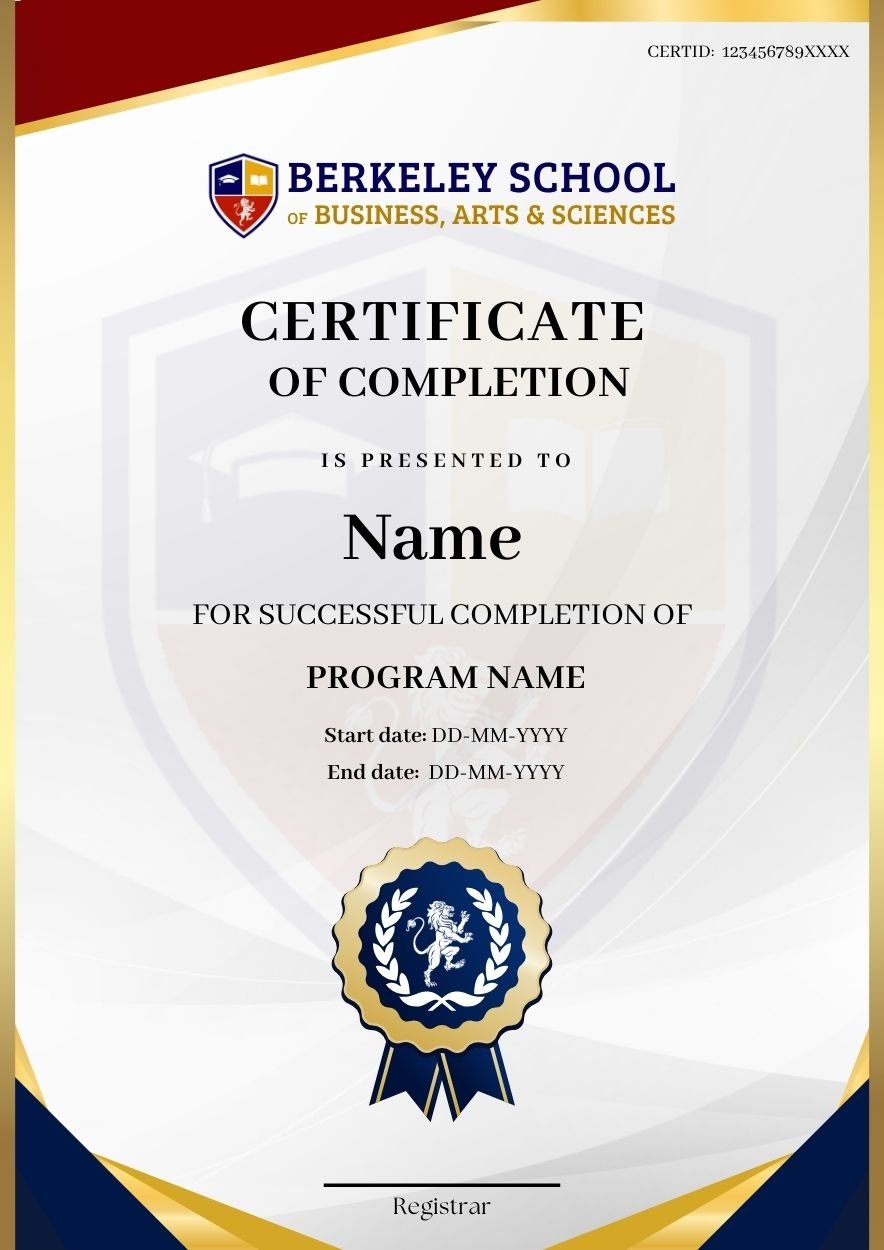
You will get a certificate of completion, which is highly reputed and accepted by employers.
CIMA P3 develops stronger professional judgement by requiring candidates to identify uncertainty, assess potential consequences, and evaluate appropriate risk responses. Moreover, these capabilities support continued development in risk management, governance, compliance, finance, and strategic decision-making.
P3 knowledge can support progression into roles involving risk management, internal audit, governance, compliance, financial risk, and strategic planning. As responsibilities increase, the ability to evaluate risk exposure and recommend appropriate responses can help professionals contribute more effectively to organizational decision-making.
P3 preparation can be organised around professional and academic commitments through a structured combination of lectures, risk-analysis exercises, revision activities, and examination practice. Therefore, candidates can maintain a consistent study routine while developing the analytical skills required for the assessment.
Contact Us