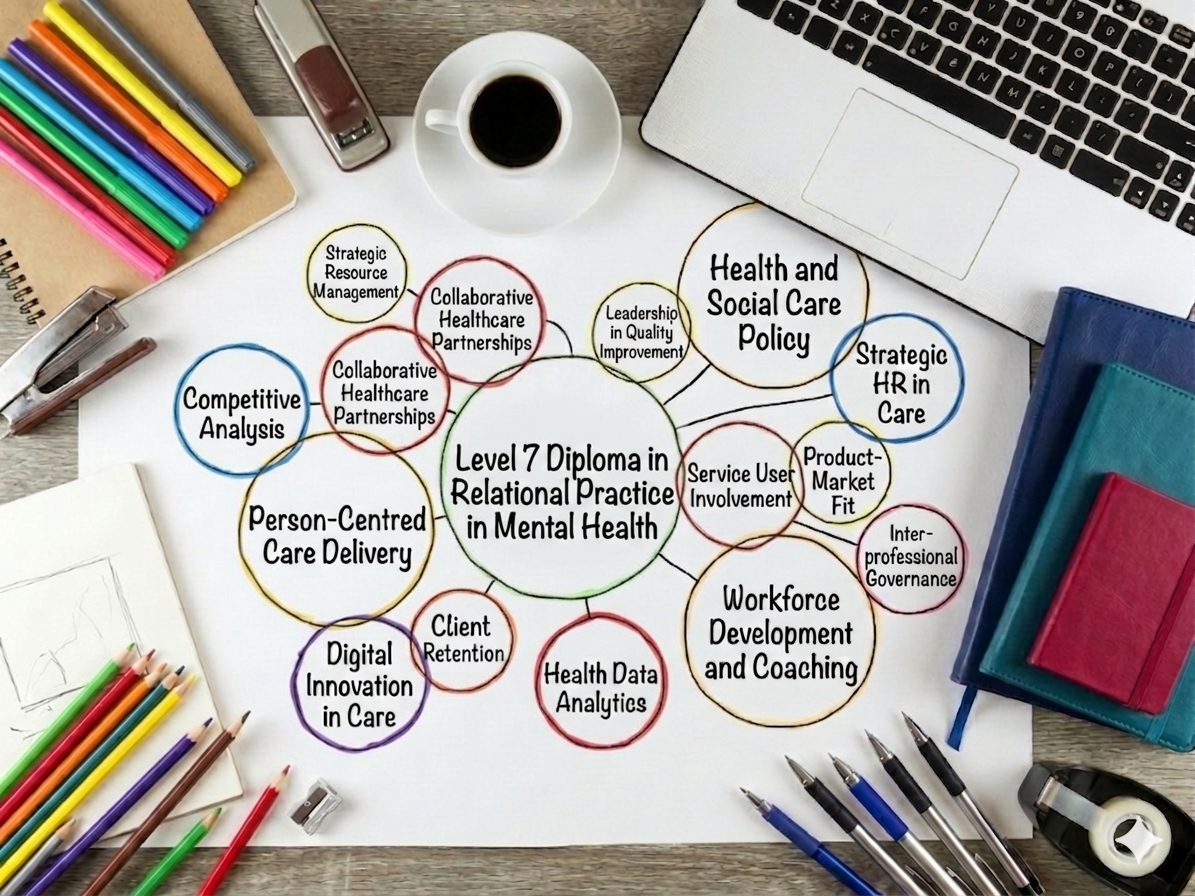
Level 7 Diploma in Relational Practice in Mental Health

BERKELEY SCHOOL OF BUSINESS, ARTS & SCIENCES

The Level 7 Diploma in Relational Practice in Mental Health (RQF: 610/2836/8) is a 120-credit postgraduate-level vocational qualification designed to equip practitioners with the technical skills and theoretical knowledge required for relational work in mental health

Overview

Postgraduate-level vocational qualification designed to provide practitioners with the advanced technical skills and theoretical knowledge required for relational practice in mental health settings. The program aims to equip trainees with the self-awareness and practical application skills necessary to work effectively with clients experiencing mental distress, including those with complex psychiatric diagnoses such as personality disorders and psychoses.

Offered By

Berkeley School of Business, Arts & Sciences 

Vision & Mission

Our mission is to bridge the gap between ambition and achievement, ensuring our students graduate prepared for the next stage of their journey.

What is the eligibility?

To enroll, applicants typically require a Level 6 qualification or a first degree, though those with extensive experience may be considered via interview.

Who can do?
anyone who is interested to learn about following concepts can pursue Level 7 Diploma in Relational Practice in Mental Health:
Theoretical Foundations, Specialized Approaches, Clinical Knowledge, Professional & Reflective Skills, Societal Context.
individuals with the following designations:
Relational practitioner.

Course Structure

Consists of six core units. These units are designed to provide the technical skills and theoretical framework required for advanced relational practice. The six units included in the course are:

Unit 1: Neurobiology, Psychodynamic Theory and Practice

This unit is designed to provide learners with an in-depth understanding of human development and the functioning of the mind.

The "Twin Lenses"

Theoretical Framework

Clinical Application

Self-Reflexivity

Unit 2: Trauma-informed Approach in Mental Health

This unit provides the applied therapeutic skills and theoretical framework necessary to engage both effectively and ethically with clients in significant emotional or psychological distress.

Collaborative Practice

Ethical Engagement

Clinical Application

Self-Awareness

Unit 3: Presenting Issues and Diagnoses in Mental Health

Designed to equip practitioners with the ability to engage effectively and ethically with clients experiencing significant emotional and psychological distress.

Clinical Engagement

Societal and Scientific Context

Relational Application

Collaborative Methodology

Ethical Professionalism

Unit 4: Enabling Recovery in Mental Health

This unit emphasizes a relational approach, equipping practitioners with the applied therapeutic skills to work effectively with individuals experiencing both diagnosed and undiagnosed mental health problems.

Collaborative Practice

Systemic Understanding

Ethical Support Systems

Applied Reasoning

Unit 5: Social Dynamics in Mental Health

This unit provides learners with a critical understanding of current models of mental health and explores how social factors influence the experience and treatment of emotional distress.
 

Societal Context

Collaborative Relationships

Systemic Engagement

Applied Theory

Unit 6: Professional Skills in Mental Health

This unit ensures that practitioners can work reflectively and thoughtfully while maintaining the high standards of conduct required in complex clinical environments.

Ethical Practice and Professional Conduct

Collaborative and Egalitarian Working

Stakeholder Engagement

Articulating Practice

Integration of Experience

Learning Methodology

Berkeley offers expertly developed learning materials tailored to meet participants' needs, ensuring comprehensive coverage of the syllabus and optimal exam preparation.

‣ Tailored Material: Guides are designed to cover the entire syllabus, offering full preparation and deep understanding.

‣ In-Depth Content: Unlike superficial outlines, our materials provide fully developed theories and concepts, equipping participants with complete knowledge.

‣ Strategic Study: We help participants prioritize study time by indicating the weight of each topic, allowing efficient focus on crucial areas.

‣ Difficulty Levels: Topics are labeled as "Awareness" or "Proficiency," guiding participants to allocate time based on the required depth of knowledge.

‣ Comprehensive Coverage: Our materials include detailed theory and a glossary of technical terms to clarify complex concepts.

‣ Effective Learning Techniques: Visual aids and memorization techniques ensure long-lasting retention, helping candidates succeed.

Berkeley’s methodologies equip participants with the essential knowledge and tools for both exams and future success.

Lecture Image
Lectures

Our lecture plan integrates structured learning with interactive teaching methods, promoting engagement and collaboration. This approach ensures a comprehensive understanding of concepts, fostering critical thinking and practical application in real-world scenarios.

Lecture Image
Practice Session

Practice sessions offer hands-on experience through guided exercises, enhancing skills and reinforcing knowledge. This practical approach ensures mastery of concepts, promoting.

Lecture Image
Mock Examination

Mock examinations simulate real test conditions, providing valuable practice and assessment. This helps identify strengths and weaknesses, ensuring thorough preparation and boosting confidence for actual exams.

Berkeley's Performance Standards

Evaluates and ensure the quality of the training program and all its deliverables.  This is measured through the following indicators:
‣ Instructors' experience and style in presenting and explaining topics.
‣ Variety and balance of teaching methods (such as discussions, case studies, mock exams and videos) used in the course to ensure retention and to match the learning objectives.
‣ Level of interactivity.
‣ Feedback from program participants
‣ Full compliance with Institute standards and guidelines for preparation and study requirements and methodology.
‣ Progress reports from the training program provider.

Success Stories

“As a strong advocate for education and human development, I commend Berkeley for its exceptional commitment to empowering future leaders. The institution stands as a symbol of excellence, innovation, and opportunity. Students who walk its halls are nurtured with knowledge, values, and vision, qualities that contribute to building a stronger and more prosperous future for our nation.”- H.H. Shaikh Khalifa Al Hamid

Visit Our Alumni

Alumni Benefits

‣ Exclusive Networking Events: Access invitations to industry-leading events and thought-leadership gatherings featuring renowned speakers.


‣ Monthly Updates: Stay informed with a newsletter highlighting the latest research, events, and activities from the school.


‣ LinkedIn Community Access: Join the Executive Education LinkedIn group for networking and professional development opportunities.


‣ Educational Discounts: Enjoy a 20% discount on open-enrollment programs and access to workshops focused on emerging trends.


‣ Global Alumni Network: Connect with a diverse alumni community through the Berkeley School’s online network and engage in country and interest groups.

Is It Worth the Investment?

This qualification is highly valued because it is regulated by Ofqual, ensuring consistent and rigorous quality standards respected by employers worldwide. Based on current market trends for senior marketing leaders, the potential annual earning power is significant:

United Kingdom: £45,000 – £75,000
United States: $70,000 – $120,000
United Arab Emirates: AED 180,000 – AED 300,000
Canada: CAD 65,000 – CAD 110,000
Saudi Arabia (KSA): SAR 160,000 – SAR 280,000

Progression Route: After the completion of Level 7 Diploma in Relational Practice in Mental Health

The program aims to equip trainees with enhanced self-awareness and practical application skills to work effectively with clients experiencing mental distress, including those with complex diagnoses such as personality disorders and psychoses. By engaging with a curriculum that includes neurobiology, psychodynamic theory, and trauma-informed approaches, learners develop high-level critical self-reflexivity and the ability to work in an egalitarian, collaborative way. Ultimately, this qualification provides a foundation for postgraduate-level self-directed research and offers clear progression routes to Level 8 studies, university Master’s degrees, or professional employment

What You Earn

You will get a certificate of completion, which is highly reputed and accepted by employers

Specialized Technical Skills

You gain the practical application skills required to work effectively with clients experiencing mental distress, including those with complex psychiatric diagnoses such as personality disorders and psychoses

Clinical Reflexivity

You achieve a high level of critical self-reflexivity and enhanced self-awareness, allowing you to manage the emotional processes inherent in therapeutic settings, particularly with individuals who have experienced significant trauma

Professional Foundation

The course provides evidence of post-graduate level self-directed research and development, enabling you to work in an egalitarian and collaborative way with clients, families, and professional colleagues

Career Advancement

This diploma acts as a bridge to employment in associated professions or higher academic pursuits, such as a Level 8 Diploma or a university Master’s degree

Professional Certification & Diploma Courses

MSc – Master of Science in Health and Care Management (Top-Up) (from UK)

Program Duration: 6 months

Program Credits: 60 credits (Dissertation only), leading to a full MSc degree when combined with a Level 7 qualification

Format: Online Distance Learning

Read More
BSc (Hons) Healthcare Management (Top-Up)

Program Duration: 12 Months
Program Credits: 120 Credits (Honours Degree Top-Up)
Entry Requirement: Level 5 Extended Diploma in Health and Social Care or equivalent
Modules: 4 Core Modules + 1 Major Project
Accreditation: CMI Accredited and IHSCM Endorsed
Format: Online Distance Learning
Intakes: January, April, and September

Read More
BSc (Hons) Integrative Health and Social Care (Top-Up) from UK

Program Duration: 12 Months
Program Credits: 120 Credits (Honours Degree Top-Up)
Entry Requirement: Level 5 Extended Diploma in Health and Social Care or equivalent
Modules: 5 Core Modules + 1 Major Project
Format: Online Distance Learning
Intakes: January, May, and September

Read More
Level 5 Extended Diploma in Health and Social Care

The Level 5 Extended Diploma in Health and Social Care is a 240-credit vocational qualification created to develop the management and care capabilities of professionals in the sector. Regulated by Ofqual, the programme represents a Total Qualification Time (TQT) of 2,400 hours and aims to bring professional recognition and professionalism to the industry. The curriculum consists of 11 units, including Academic Study Skills, Healthcare Policy, Reflective Practice, and a Research Project. Successful graduates are eligible to progress directly to the final year of an Honours degree

Read More
IAA Level 1 Immigration Law & Firm Registration Training Programme

Comprehensive IAA Level 1 Immigration Law training with full firm registration guidance, expert-led sessions, mock tests, and a 95% success rate. Designed to support you from preparation to successful registration.

Read More

FAQ: Level 7 Diploma in Relational Practice in Mental Health

Contact Us 

Cart

Cart (0)