Program Duration: 12 Months
Program Credits: 120 Credits (Honours Degree Top-Up)
Entry Requirement: Level 5 Extended Diploma in Health and Social Care or equivalent
Modules: 5 Core Modules + 1 Major Project
Format: Online Distance Learning
Intakes: January, May, and September
The BSc Hons Integrative Health and Social Care develops advanced knowledge and practical skills for professionals working across health and social care environments. Moreover, the curriculum explores integrative approaches that connect health, wellbeing, social care, and community-based practice. Furthermore, learners examine leadership and management principles relevant to care services and professional teams. In addition, the program covers safeguarding, ethical practice, equality, and person-centered approaches to care delivery. Consequently, learners develop the ability to evaluate care practices and identify opportunities for meaningful service improvement. Moreover, applied learning activities encourage critical thinking, evidence-based practice, and effective decision-making. Furthermore, learners strengthen their research and analytical capabilities through a major project focused on a relevant health or social care issue. The program also supports effective communication, collaborative working, and responsible professional practice. Therefore, graduates can apply their knowledge across health services, social care providers, community organizations, and related sectors. Ultimately, the BSc (Hons) Integrative Health and Social Care provides a strong academic foundation for professional development, leadership, service improvement, and further study.
| Program Area | Key Focus |
|---|---|
| Integrative Health & Social Care | Connecting health, wellbeing, social care, and community-based approaches |
| Leadership & Management | Developing leadership and management skills for care services |
| Safeguarding | Promoting safety, protection, and responsible care practices |
| Ethical Practice | Applying ethical principles to professional health and social care decisions |
| Person-Centered Care | Supporting individual needs, dignity, choice, and wellbeing |
| Service Improvement | Identifying opportunities to improve care quality and service delivery |
| Applied Learning | Applying theoretical knowledge to practical health and social care contexts |
| Research Skills | Developing research methods, critical analysis, and evidence-based practice |
| Major Project | Conducting an independent project addressing a relevant health or social care issue |
| Career Preparation | Preparing learners for professional roles across health, social care, and community organizations |
The BSc Hons Integrative Health and Social Care (Top-Up) is an accelerated undergraduate pathway that allows learners with a relevant Level 5 qualification to progress directly to the final year of a UK Honours degree. Instead of repeating earlier stages of study, learners complete advanced modules and a major project to fulfil the remaining credit requirements.
This program is ideal for individuals currently working in or aspiring to work within health and social care environments, including care services, community organizations, and support agencies. It is particularly suited to diploma holders and practitioners seeking to enhance their leadership, management, and service-delivery skills, progress into senior roles, or pursue further academic study in health, social care, or related disciplines.
Enrollment is ongoing for January, May, and September intakes.
A Top-Up degree provides a direct pathway to achieving a full UK Honors degree after completing a Level 5 qualification in Health and Social Care or an equivalent discipline.
The following are the key highlights of the programme:
Students complete six 20-credit modules totaling 120 credits: three core modules and one module from each optional group.
These compulsory modules develop interdisciplinary practice, research preparation and the application of evidence within health and social care.
Integrating Practices – 20 Credits
Preparing for Research and Evidence Based Practice – 20 Credits
Research and Evidence in Practice – 20 Credits
Students select one module examining either organizational leadership or support for people experiencing psychological distress.
Leadership and Management in Health and Social Care – 20 Credits
Working with People with Distress and Disorder – 20 Credits
Students select one specialist module addressing education, vulnerability, public health or palliative care practice.
Educating in Health and Social Care – 20 Credits
Working with Vulnerable People – 20 Credits
Public Health: UK and International Perspectives – 20 Credits
Advanced Concepts in Palliative Care – 20 Credits
Students select one module exploring therapeutic relationships or collaborative approaches to dementia care.
Relationships Informed by Cognitive Behavioural Therapy – 20 Credits
Partnerships in Dementia Care – 20 Credits
Berkeley offers expertly developed learning materials tailored to meet participants' needs, ensuring comprehensive coverage of the syllabus and optimal exam preparation.
‣ Tailored Material: Guides are designed to cover the entire syllabus, offering full preparation and deep understanding.
‣ In-Depth Content: Unlike superficial outlines, our materials provide fully developed theories and concepts, equipping participants with complete knowledge.
‣ Strategic Study: We help participants prioritize study time by indicating the weight of each topic, allowing efficient focus on crucial areas.
‣ Difficulty Levels: Topics are labeled as "Awareness" or "Proficiency," guiding participants to allocate time based on the required depth of knowledge.
‣ Comprehensive Coverage: Our materials include detailed theory and a glossary of technical terms to clarify complex concepts.
‣ Effective Learning Techniques: Visual aids and memorization techniques ensure long-lasting retention, helping candidates succeed.
Berkeley’s methodologies equip participants with the essential knowledge and tools for both exams and future success.
Our lecture plan integrates structured learning with interactive teaching methods, promoting engagement and collaboration. This approach ensures a comprehensive understanding of concepts, fostering critical thinking and practical application in real-world scenarios
Practice sessions offer hands-on experience through guided exercises, enhancing skills and reinforcing knowledge. This practical approach ensures mastery of concepts, promoting confidence and competence in real-world applications
Mock examinations simulate real test conditions, providing valuable practice and assessment. This helps identify strengths and weaknesses, ensuring thorough preparation and boosting confidence for actual exams
Evaluates and ensure the quality of the training program and all its deliverables. This is measured through the following indicators:
‣ Instructors' experience and style in presenting and explaining topics.
‣ Variety and balance of teaching methods (such as discussions, case studies, mock exams and videos) used in the course to ensure retention and to match the learning objectives.
‣ Level of interactivity.
‣ Feedback from program participants
‣ Full compliance with Institute standards and guidelines for preparation and study requirements and methodology.
‣ Progress reports from the training program provider.
“As a strong advocate for education and human development, I commend Berkeley for its exceptional commitment to empowering future leaders. The institution stands as a symbol of excellence, innovation, and opportunity. Students who walk its halls are nurtured with knowledge, values, and vision—qualities that contribute to building a stronger and more prosperous future for our nation.”- H.H. Shaikh Khalifa Al Hamid
Alumni Benefits
‣ Exclusive Networking Events: Access invitations to industry-leading events and thought-leadership gatherings featuring renowned speakers.
‣ Monthly Updates: Stay informed with a newsletter highlighting the latest research, events, and activities from the school.
‣ LinkedIn Community Access: Join the Executive Education LinkedIn group for networking and professional development opportunities.
‣ Educational Discounts: Enjoy a 20% discount on open-enrollment programs and access to workshops focused on emerging trends.
‣ Global Alumni Network: Connect with a diverse alumni community through the Berkeley School’s online network and engage in country and interest groups.
The BSc (Hons) Integrative Health and Social Care develops advanced knowledge and practical skills in integrative care, person-centered practice, safeguarding, ethical decision-making, leadership and management, service improvement, research, and health and social care practice. Moreover, it strengthens professional capabilities and supports career progression into roles such as Health and Social Care Manager, Care Coordinator, Social Care Practitioner, Community Support Worker, Health and Wellbeing Coordinator, Care Service Manager, Safeguarding Officer, Service Improvement Officer, and Community Health Professional.
Potential Career Earnings After Completing the Degree:
Upon successful completion of the BSc Hons Integrative Health and Social Care (Top-Up) program, learners become eligible to progress to a range of postgraduate and professional development pathways, subject to individual entry requirements.
This progression route enables continued academic advancement and career development within the health and social care sector. Explore more BSc (Hons) – Bachelor of Science in Business Management (Top-Up) (from UK), BSc (Hons) – Bachelor of Science in Computing and Information Technology (Top-Up) (from UK), BSc (Hons) – Bachelor of Science in Business Computing & IT (Top-Up) (from UK) and Skills for Care - Person-Centered Approaches in Health and Care — Relevant to person-centered care, workforce development, and care practice, Skills for Care - Care Certificate Standards — Useful for UK health and social care skills, knowledge, and professional standards, Care Quality Commission - Fundamental Standards of Care — Supports content relating to person-centred care, dignity, safety, and quality standards and Care Quality Commission - Person-Centred Care — Relevant to personalised care planning, individual needs, independence, and quality of life.
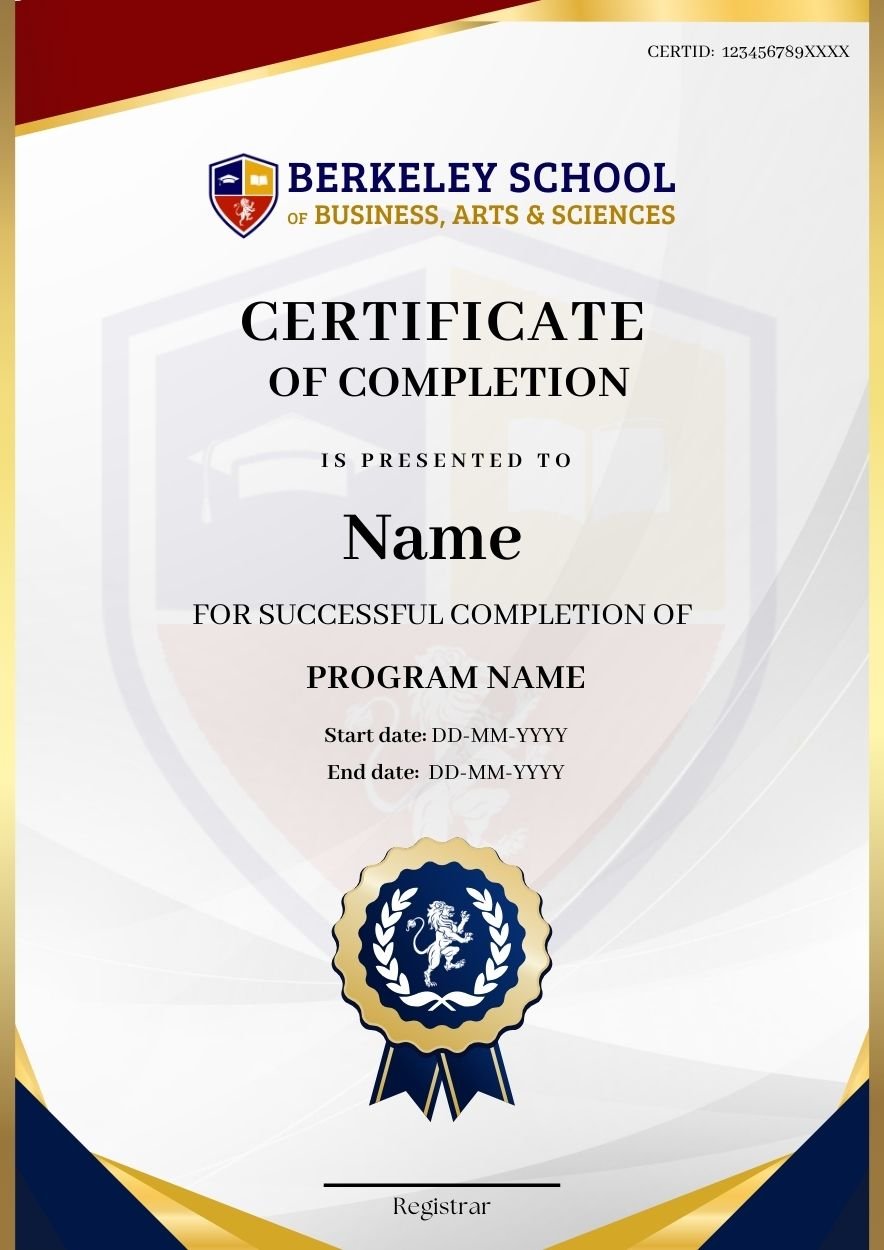
You will get a certificate of completion, which is highly reputed and accepted by employers
Builds knowledge of safeguarding principles, risk management, and ethical responsibilities to promote safe and supportive health and social care environments.
Develops research, analytical, and evidence-based decision-making skills to evaluate care practices and contribute to continuous service improvement.
Strengthens leadership and management skills for coordinating care teams, improving service delivery, and supporting effective organizational performance.
Contact Us