Upon completion of the crash-course, participants will have a solid understanding of customs and trade compliance management, enabling them to effectively navigate regulatory requirements, mitigate risks, and ensure compliance within their organizations.
We are pleased to offer a crash-course specifically focused on customs and trade compliance management. This intensive and condensed program is designed to provide participants with a solid foundation in the essential principles and practices of customs regulations and trade compliance.
During the crash-course, participants will gain a comprehensive understanding of key topics, including customs procedures, import and export regulations, tariff classification, valuation, rules of origin, documentation requirements, and compliance best practices. Through a combination of interactive lectures, case studies, and practical exercises, participants will acquire the necessary knowledge and skills to navigate the complexities of customs and trade compliance.
Our experienced instructors, who possess in-depth expertise in customs and trade regulations, will guide participants through real-world scenarios, addressing common challenges and sharing insights from their professional experiences. The crash-course also provides an opportunity to engage with fellow professionals, fostering knowledge-sharing and networking.
Berkeley School of Business, Arts & Sciences
Following a brief welcome, this session sets the scene. It gives an overview of applicable trade and customs policy and its relevance to:
This session also looks at:
Short exercises are conducted to identify key learning needs and individual focus areas. These will be revisited throughout to enable participants set personal action points.
Here we dive into the technical by explaining how to calculate applicable customs import duties. Participants are thus introduced to tariff classification so that they are able to refer to their goods in the applicable tariff schedule. Duty rates can then be calculated by reference to relevant customs valuation and preferential origin rules. Practical examples are provided, including an overview of the documents that are often needed to take advantage of preferential trade arrangements. We also discuss possible duty exemptions for low-value shipments, available business support services, binding decisions, and the use of supporting online tools and reference resources.
Who is responsible for what can be a tricky question, especially when starting out or when things go wrong? It is best to prepare and be clear about compliance responsibilities from day one. We will thus look at standard commercial terms between buyers and sellers – the so-called Incoterms – and explore their respective implications within the context of duty payment liabilities, other indirect taxes (e.g. VAT), distribution models, and customer service expectations.
In this session, we will also take a look at the services offered by customs agents, freight forwarders, and brokers. This is followed by and detailed overview of how trade and customs declarations are submitted to the relevant authorities along with possible software, registration, authorization, licensing, permit, and certification requirements.
Discussed, too, are advance (pre-arrival / pre-departure) declaration requirements, the use of electronic systems, scope for automation, and simplified arrangements – e.g. for shipments sent by post or shipments destined for inland clearance. Important not to forget are the arrangements for physical inspections, their potential costs, and the risk of penalties and fines.
This might look like a very busy session – but it all links together and will be approached in a digestible and practical way!
This block concerns costs and competitiveness. We will look at access to advantageous customs treatment, such as: customs warehousing; special export processing arrangements; customs freezones; amongst others. Trusted Trader and Authorised Economic Operator programmes are highlighted, too.
In this final session we will also expand on:
Berkeley offers expertly developed learning materials tailored to meet participants' needs, ensuring comprehensive coverage of the syllabus and optimal exam preparation.
‣ Tailored Material: Guides are designed to cover the entire syllabus, offering full preparation and deep understanding.
‣ In-Depth Content: Unlike superficial outlines, our materials provide fully developed theories and concepts, equipping participants with complete knowledge.
‣ Strategic Study: We help participants prioritize study time by indicating the weight of each topic, allowing efficient focus on crucial areas.
‣ Difficulty Levels: Topics are labeled as "Awareness" or "Proficiency," guiding participants to allocate time based on the required depth of knowledge.
‣ Comprehensive Coverage: Our materials include detailed theory and a glossary of technical terms to clarify complex concepts.
‣ Effective Learning Techniques: Visual aids and memorization techniques ensure long-lasting retention, helping candidates succeed.
Berkeley’s methodologies equip participants with the essential knowledge and tools for both exams and future success.
Our lecture plan integrates structured learning with interactive teaching methods, promoting engagement and collaboration. This approach ensures a comprehensive understanding of concepts, fostering critical thinking and practical application in real-world scenarios
Practice sessions offer hands-on experience through guided exercises, enhancing skills and reinforcing knowledge. This practical approach ensures mastery of concepts, promoting confidence and competence in real-world applications
Mock examinations simulate real test conditions, providing valuable practice and assessment. This helps identify strengths and weaknesses, ensuring thorough preparation and boosting confidence for actual exams
Evaluates and ensure the quality of the training program and all its deliverables. This is
measured through the following indicators:
‣ Instructors' experience and style in presenting and
explaining topics.
‣ Variety and balance of teaching methods (such as discussions, case studies,
mock exams and videos) used in the course to ensure retention and to match the learning
objectives.
‣ Level of interactivity.
‣ Feedback from program participants
‣ Full
compliance with Institute standards and guidelines for preparation and study requirements and
methodology.
‣ Progress reports from the training program provider.
Ideal for disciplined learners who prefer flexibility
Learn from expert instructors in real-time
Personalized, intensive learning experience
“As a strong advocate for education and human development, I commend Berkeley for its exceptional commitment to empowering future leaders. The institution stands as a symbol of excellence, innovation, and opportunity. Students who walk its halls are nurtured with knowledge, values, and vision—qualities that contribute to building a stronger and more prosperous future for our nation.”- H.H. Shaikh Khalifa Al Hamid
‣ Exclusive Networking Events: Access invitations to industry-leading events and thought-leadership gatherings featuring renowned speakers.
‣ Monthly Updates: Stay informed with a newsletter highlighting the latest research, events, and activities from the school.
‣ LinkedIn Community Access: Join the Executive Education LinkedIn group for networking and professional development opportunities.
‣ Educational Discounts: Enjoy a 20% discount on open-enrollment programs and access to workshops focused on emerging trends.
‣ Global Alumni Network: Connect with a diverse alumni community through the Berkeley School’s online network and engage in country and interest groups.
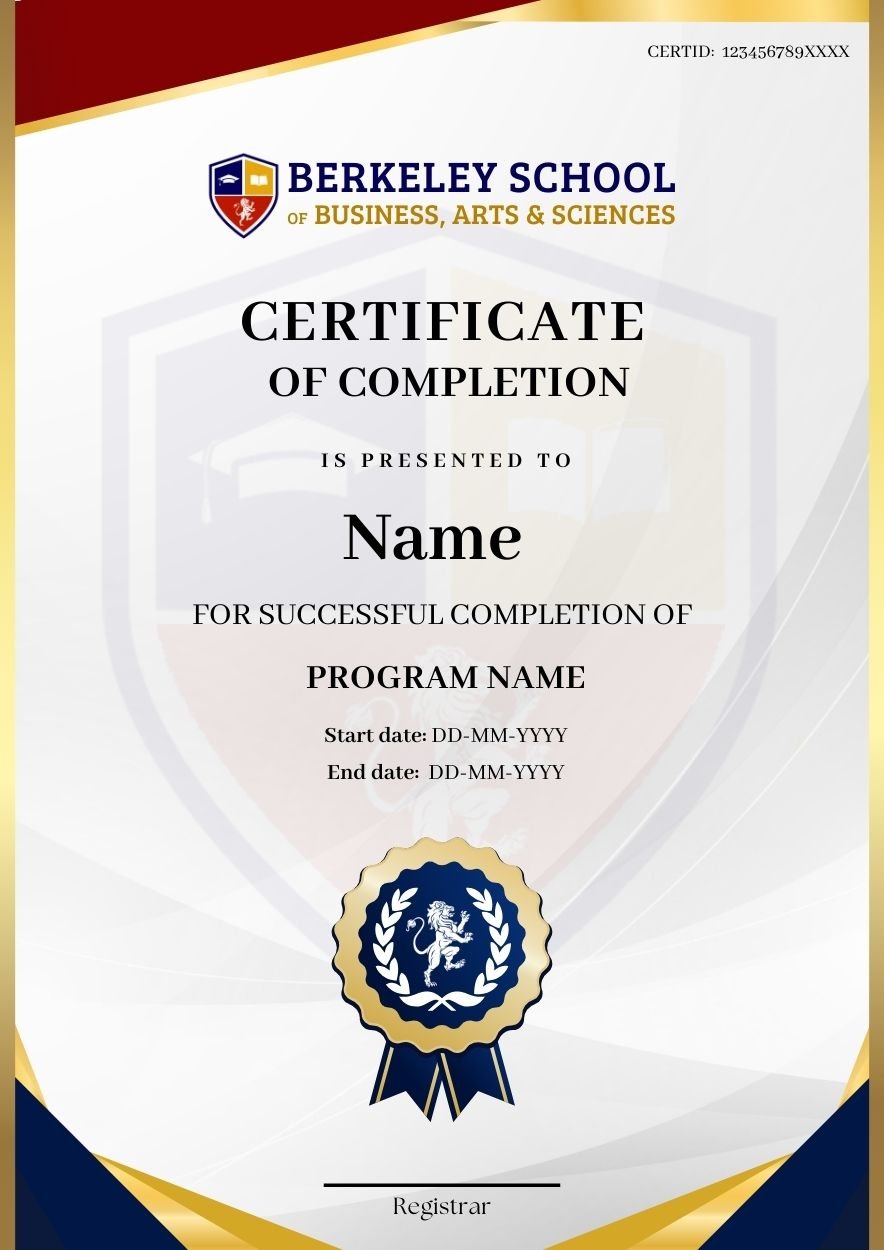
You will get a certificate of completion, which is highly reputed and accepted by employers.