Program Duration: Minimum 2 Years (Direct Entry into 3rd Year)
Entry Requirement: Completed Master’s Degree and Level 8 Diploma (or equivalent)
Program Level: Doctoral (Advanced Entry / Top-Up)
Format: Online Distance Learning
Intakes: January and September
The DBA Doctor of Business Administration is an advanced professional doctoral program designed for experienced business professionals seeking to enhance their strategic, analytical, and leadership capabilities. Moreover, it develops advanced knowledge of business management, organizational strategy, leadership, and decision-making. Furthermore, learners engage with applied research to investigate complex business challenges and develop practical solutions. The program also strengthens critical thinking, research methodology, and evidence-based decision-making skills. In addition, learners can explore contemporary issues affecting organizations, markets, leadership, and business performance. Consequently, the DBA Doctor of Business Administration supports professionals in connecting academic research with real-world organizational practice. Moreover, the qualification can enhance professional credibility and prepare learners for senior leadership, consulting, research, and strategic management roles. Furthermore, learners develop the ability to evaluate business problems from a strategic and research-driven perspective. Therefore, the program provides a strong foundation for continuous professional development and advanced academic engagement. Ultimately, the DBA Doctor of Business Administration is suited to professionals who want to generate practical knowledge and contribute to organizational and business development.
| Key Area | What You Will Develop |
|---|---|
| Strategic Leadership | Advanced leadership and strategic decision-making capabilities |
| Business Management | In-depth understanding of contemporary business and management practices |
| Applied Research | Ability to conduct research addressing complex organizational challenges |
| Critical Thinking | Advanced analytical and evaluative skills for business decisions |
| Research Methodology | Knowledge of research design, methods, analysis, and academic investigation |
| Organizational Strategy | Skills to evaluate and develop effective organizational strategies |
| Problem Solving | Ability to identify complex business problems and develop practical solutions |
| Professional Development | Enhanced credibility and preparation for senior business responsibilities |
| Academic Contribution | Opportunity to generate knowledge through applied doctoral research |
| Career Progression | Preparation for senior leadership, consultancy, research, and strategic roles |
The DBA Doctor of Business Administration is an accelerated doctoral pathway that allows holders of a relevant master’s degree and/or Level 8 qualification to progress directly into the final research stage of the Doctor of Business Administration. Instead of completing the full DBA curriculum, learners focus primarily on advanced doctoral research and thesis submission to fulfill the remaining credit and award requirements.
The DBA Doctor of Business Administration Program is ideal for senior professionals, executives, consultants, entrepreneurs, and academic practitioners seeking a doctoral qualification without interrupting their careers. It is particularly suited for individuals aiming to enhance strategic leadership capability, conduct applied business research, influence organizational and policy decisions, and achieve recognition at the highest professional level across global industries.
Enrollment is ongoing for January and September intakes.
The DBA Doctor of Business Administration Program is designed to enable qualified professionals to complete a full Doctor of Business Administration (DBA) by building on prior postgraduate and doctoral-level learning, with a strong emphasis on applied research and strategic impact.
The following are the key highlights of the DBA program:
This stage develops the advanced research capabilities required to investigate complex organizational problems. Students examine qualitative and quantitative methodologies, engaged scholarship and evidence-based management while learning to produce and communicate doctoral-level research.
Philosophy and Practice of Engaged Scholarship
Qualitative Research I and II
Quantitative Research I and II
Evidence-Based Management
Creating and Disseminating Research Knowledge
This stage connects contemporary business theory with senior-level professional practice. Students critically examine leadership, organizational management, digital transformation and executive decision-making within complex and rapidly changing environments.
Leadership to Create Human Value
Theory and Practice of Managing Organizations
Theory and Practice of Digital Transformation
Business Topics and Theory
Influences and Limitations on Executive Decision-Making
Candidates undertake an original applied research project addressing a significant contemporary business problem. Working with a doctoral adviser and dissertation committee, students' progress from proposal development through data collection and analysis to the final dissertation and oral defense.
Identification of the Business Research Problem
Dissertation Proposal and Literature Review
Research Design and Ethical Approval
Data Collection and Analysis
Findings and Contribution to Professional Practice
Dissertation Writing and Revision
Oral Dissertation Defense
Berkeley offers expertly developed learning materials tailored to meet participants' needs, ensuring comprehensive coverage of the syllabus and optimal exam preparation.
‣ Tailored Material: Guides are designed to cover the entire syllabus, offering full preparation and deep understanding.
‣ In-Depth Content: Unlike superficial outlines, our materials provide fully developed theories and concepts, equipping participants with complete knowledge.
‣ Strategic Study: We help participants prioritize study time by indicating the weight of each topic, allowing efficient focus on crucial areas.
‣ Difficulty Levels: Topics are labeled as "Awareness" or "Proficiency," guiding participants to allocate time based on the required depth of knowledge.
‣ Comprehensive Coverage: Our materials include detailed theory and a glossary of technical terms to clarify complex concepts.
‣ Effective Learning Techniques: Visual aids and memorization techniques ensure long-lasting retention, helping candidates succeed.
Berkeley’s methodologies equip participants with the essential knowledge and tools for both exams and future success.
Evaluates and ensure the quality of the training program and all its deliverables. This is measured through the following indicators:
‣ Instructors' experience and style in presenting and explaining topics.
‣ Variety and balance of teaching methods (such as discussions, case studies, mock exams and videos) used in the course to ensure retention and to match the learning objectives.
‣ Level of interactivity.
‣ Feedback from program participants
‣ Full compliance with Institute standards and guidelines for preparation and study requirements and methodology.
‣ Progress reports from the training program provider.
“As a strong advocate for education and human development, I commend Berkeley for its exceptional commitment to empowering future leaders. The institution stands as a symbol of excellence, innovation, and opportunity. Students who walk its halls are nurtured with knowledge, values, and vision—qualities that contribute to building a stronger and more prosperous future for our nation.”- H.H. Shaikh Khalifa Al Hamid
Alumni Benefits
‣ Exclusive Networking Events: Access invitations to industry-leading events and thought-leadership gatherings featuring renowned speakers.
‣ Monthly Updates: Stay informed with a newsletter highlighting the latest research, events, and activities from the school.
‣ LinkedIn Community Access: Join the Executive Education LinkedIn group for networking and professional development opportunities.
‣ Educational Discounts: Enjoy a 20% discount on open-enrollment programs and access to workshops focused on emerging trends.
‣ Global Alumni Network: Connect with a diverse alumni community through the Berkeley School’s online network and engage in country and interest groups.
The DBA Doctor of Business Administration develops advanced knowledge and practical expertise in strategic management, executive leadership, organizational development, business research, evidence-based decision-making, and complex business problem-solving. Moreover, it strengthens professional credibility and supports career progression into roles such as Chief Executive Officer, Business Director, Strategic Management Consultant, Executive Manager, Business Development Director, Management Consultant, Corporate Strategy Manager, and Senior Business Analyst.
Potential Career Earnings After Completing the Degree:
Upon successful completion of the DBA Doctor of Business Administration, learners may progress into advanced executive, academic, research, and consultancy pathways, subject to institutional, professional, and regulatory requirements.
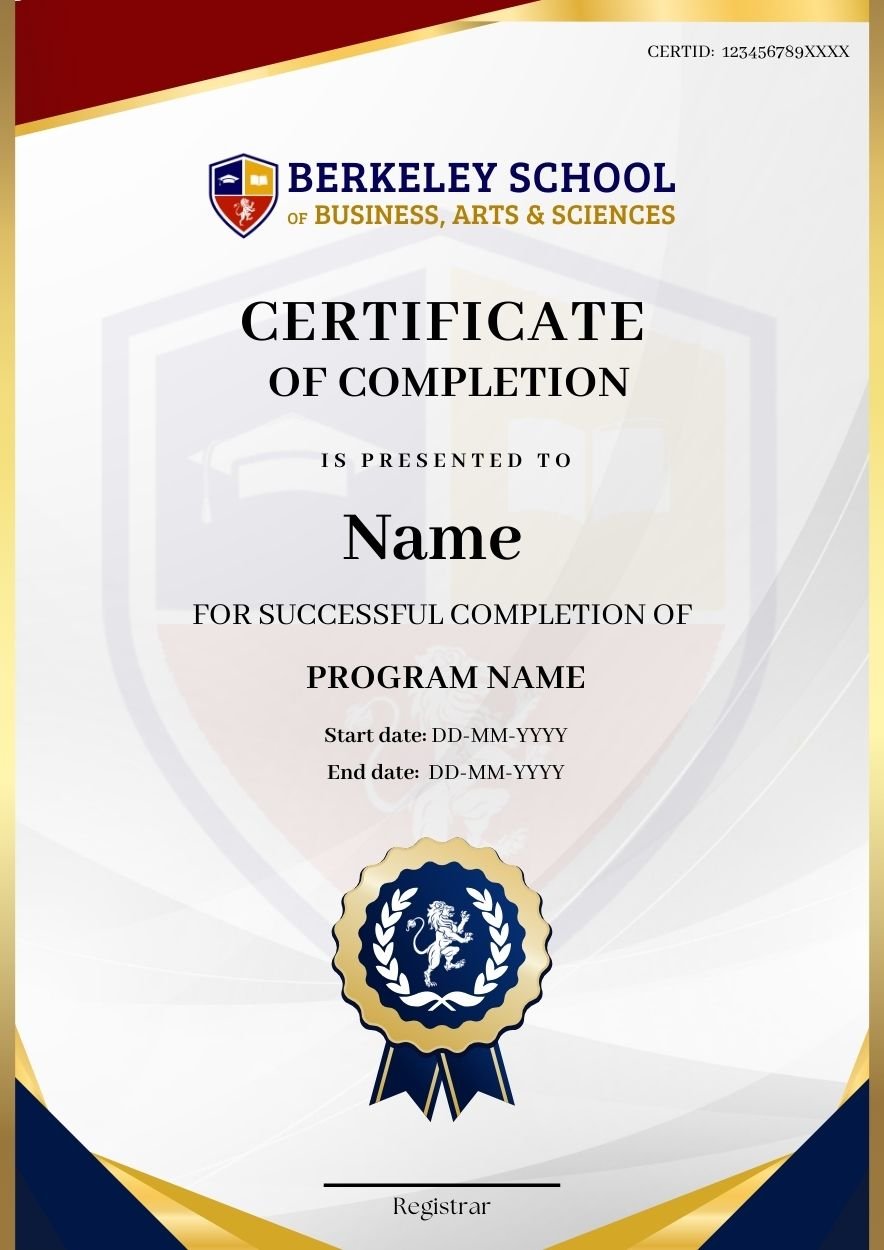
You will get a certificate of completion, which is highly reputed and accepted by employers
Strengthen doctoral-level research skills and apply evidence-based approaches to complex organizational and business challenges.
Prepare for senior executive, consultancy, strategic advisory, academic research, and business leadership opportunities.
Build advanced expertise in business strategy, innovation, organizational development, and solving complex management problems.
Contact Us