Artificial Intelligence for Business is a practical, nontechnical course that helps professionals use artificial intelligence (AI), generative AI, and automation to improve decision-making, productivity, customer experience, and business growth. Throughout the course, participants explore practical AI applications that can be implemented across different business functions. In addition, they learn how to identify opportunities for automation, enhance operational efficiency, and make data-informed decisions. Furthermore, the program demonstrates how AI can support innovation, streamline workflows, and improve organizational performance. As a result, learners gain the confidence and practical skills to apply AI technologies effectively in today's business environment.
Artificial Intelligence for Business equips managers, entrepreneurs, and professionals with the knowledge required to evaluate and apply AI across modern organizations. Throughout the course, participants explore essential AI concepts in clear, accessible business language, including machine learning, generative AI, intelligent automation, natural language processing, predictive analytics, and AI-supported decision-making. As a result, learners gain a solid understanding of how AI can create measurable business value.
Furthermore, participants examine practical AI applications across marketing, finance, human resources, operations, customer service, supply chain management, and strategic planning. In addition, they learn how to identify high-value AI opportunities, assess organizational and data readiness, compare available solutions, and develop realistic business cases for AI adoption. Consequently, they are better prepared to make informed technology investment decisions.
Moreover, the course addresses prompt design, AI project planning, implementation risks, cybersecurity, privacy, bias, transparency, and responsible AI governance. Through business scenarios, case studies, and applied activities, participants develop an AI adoption roadmap that aligns technology investments with organizational objectives and measurable outcomes. Finally, advanced programming knowledge is not required, therefore professionals from both technical and non-technical backgrounds can confidently apply AI to improve productivity, innovation, and business performance.
| Feature | Details |
|---|---|
| Delivery Mode | Classroom, Live Online, or Blended Learning |
| Prerequisites | No programming experience is required. However, basic business knowledge is recommended. |
| Key Topics | AI Fundamentals, Generative AI, Prompt Engineering, Business Applications, AI Strategy, Data Readiness, Governance, Ethics, Risk Management, and AI Adoption Planning |
| Who Should Attend | Business leaders, managers, executives, entrepreneurs, consultants, project managers, and professionals seeking to apply AI in business |
| Learning Outcomes | Identify AI opportunities, develop AI strategies, evaluate AI investments, implement AI initiatives, and measure business impact |
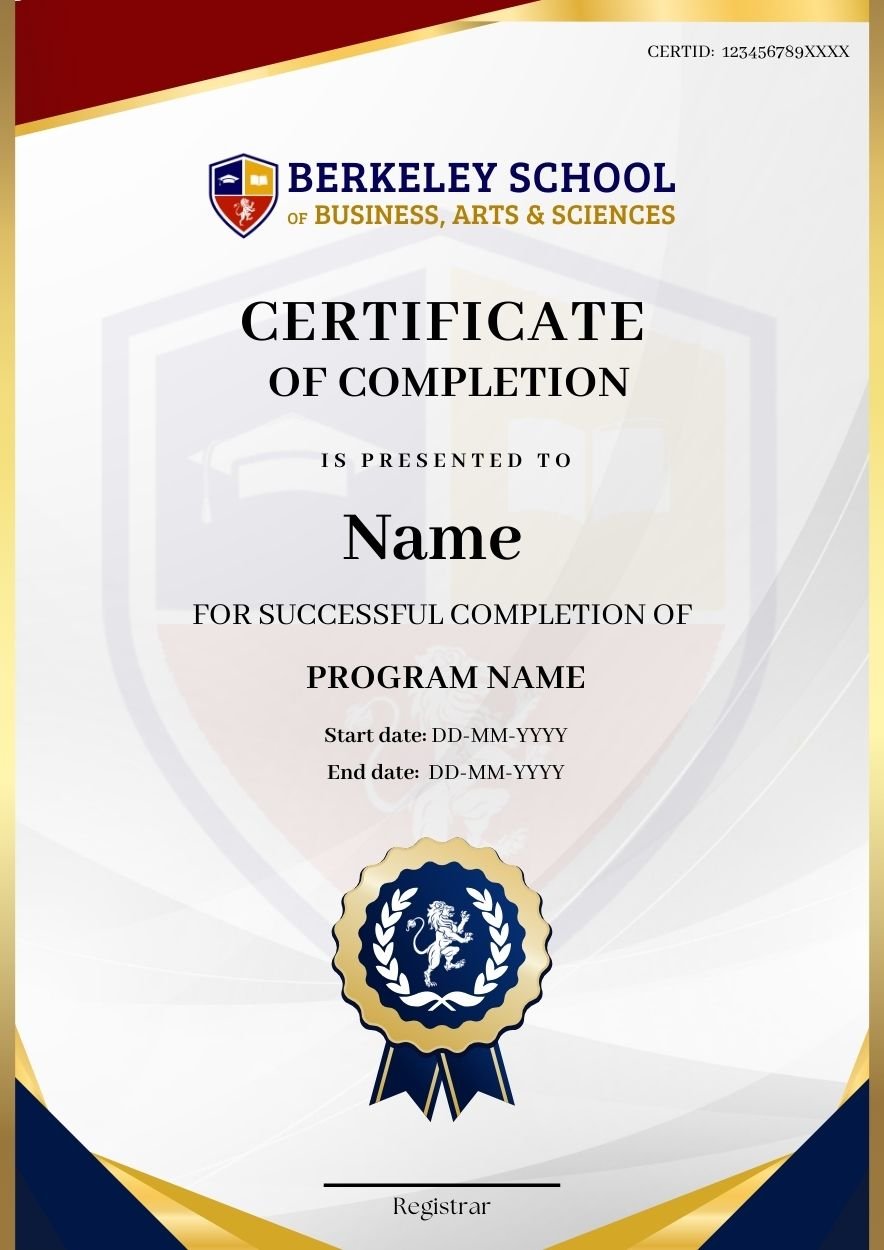
| Certificate | Participants who successfully complete the course requirements will receive a Certificate in Artificial Intelligence for Business from Berkeley School of Business & Arts Sciences. |
Berkeley School of Business, Arts & Sciences
Our vision is to empower professionals and organisations to lead responsible, innovative, and sustainable business transformation through artificial intelligence. To achieve this, our mission is to provide accessible, practical, and business-focused education that enables learners to understand, evaluate, and implement AI solutions effectively. Furthermore, the program helps participants identify valuable AI opportunities, improve decision-making, and integrate AI into business processes with confidence. In addition, it develops the skills needed to manage implementation risks, promote responsible AI governance, and align technology investments with organisational objectives. As a result, learners are equipped to deliver measurable business outcomes, enhance operational performance, and drive long-term organizational success through the strategic use of artificial intelligence.
This module introduces artificial intelligence in clear business language. Participants explore major AI technologies, their capabilities and limitations, and how organisations use them to improve efficiency, innovation, decision-making and customer value.
Evolution and Essential Terminology of Artificial Intelligence
Machine Learning, Deep Learning, NLP and Generative AI
Business Value and Real-World AI Applications
AI Limitations, Risks and Human Oversight
This module examines generative AI tools and their use in everyday business activities. Participants learn to write effective prompts, improve outputs and apply generative AI responsibly to research, communication, content and productivity tasks.
Understanding Generative AI and Large Language Models
Writing Effective Business Prompts
Generative AI for Content, Research and Productivity
Validating Outputs and Protecting Confidential Information
This module explores practical AI applications across major organizational departments. Participants evaluate how AI can improve customer engagement, forecasting, automation, workforce management and operational performance.
AI in Marketing, Sales and Customer Experience
AI in Finance, Forecasting and Risk Management
AI in Human Resources and Workforce Planning
AI in Operations, Supply Chains and Customer Service
This module explains how reliable data supports effective artificial intelligence and business decisions. Participants learn to assess data readiness, interpret AI-generated insights and establish performance measures for AI-supported initiatives.
Data Foundations and Organizational Readiness
Predictive Analytics and AI-Supported Decisions
Data Quality, Integration and Accessibility
Business Intelligence, KPIs and Performance Measurement
This module develops the ability to identify, evaluate and prioritize AI opportunities. Participants learn to connect AI investments with organizational strategy, develop business cases and compare implementation options.
Identifying High-Value AI Opportunities
Prioritizing Use Cases by Value, Feasibility and Risk
Developing the AI Business Case and Measuring ROI
Build, Buy or Partner Decisions for AI Solutions
This module covers the practical implementation of AI initiatives from pilot planning through organizational adoption. Participants learn to establish teams, manage stakeholders, select vendors and scale successful solutions.
AI Project Lifecycle and Pilot Planning
Building Cross-Functional AI Teams
Vendor Selection and Solution Evaluation
Change Management, Adoption and Scalable Implementation
This module examines the ethical, legal, security and governance responsibilities associated with business AI. Participants learn to manage bias, privacy, cybersecurity, transparency and accountability throughout the AI lifecycle.
Responsible AI Principles and Ethical Decision-Making
Bias, Fairness, Transparency and Explainability
Privacy, Cybersecurity and Data Protection
AI Governance, Accountability and Regulatory Compliance
This final module integrates the course concepts into a practical AI adoption plan. Participants assess organizational maturity, select a valuable use case and develop a responsible implementation roadmap with measurable outcomes.
Assessing Organisational AI Maturity
Selecting and Defining the Applied Business Use Case
Developing the AI Implementation Roadmap and KPIs
Presenting the Final AI Business Proposal
Berkeley offers expertly developed learning materials tailored to meet participants' needs, ensuring comprehensive coverage of the syllabus and optimal exam preparation.
‣ Tailored Material: Guides are designed to cover the entire syllabus, offering full preparation and deep understanding.
‣ In-Depth Content: Unlike superficial outlines, our materials provide fully developed theories and concepts, equipping participants with complete knowledge.
‣ Strategic Study: We help participants prioritize study time by indicating the weight of each topic, allowing efficient focus on crucial areas.
‣ Difficulty Levels: Topics are labeled as "Awareness" or "Proficiency," guiding participants to allocate time based on the required depth of knowledge.
‣ Comprehensive Coverage: Our materials include detailed theory and a glossary of technical terms to clarify complex concepts.
‣ Effective Learning Techniques: Visual aids and memorization techniques ensure long-lasting retention, helping candidates succeed.
Berkeley’s methodologies equip participants with the essential knowledge and tools for both exams and future success.
Our lecture plan integrates structured learning with interactive teaching methods, promoting engagement and collaboration. This approach ensures a comprehensive understanding of concepts, fostering critical thinking and practical application in real-world scenarios.
Practice sessions offer hands-on experience through guided exercises, enhancing skills and reinforcing knowledge. This practical approach ensures mastery of concepts, promoting.
Mock examinations simulate real test conditions, providing valuable practice and assessment. This helps identify strengths and weaknesses, ensuring thorough preparation and boosting confidence for actual exams.
Evaluates and ensure the quality of the training program and all its deliverables. This is measured through the following indicators:
‣ Instructors' experience and style in presenting and explaining topics.
‣ Variety and balance of teaching methods (such as discussions, case studies, mock exams and videos) used in the course to ensure retention and to match the learning objectives.
‣ Level of interactivity.
‣ Feedback from program participants
‣ Full compliance with Institute standards and guidelines for preparation and study requirements and methodology.
‣ Progress reports from the training program provider.
This course uses practical, application-based assessments rather than a single external examination. Learners demonstrate their understanding through quizzes, business case analyses, prompt-engineering exercises, AI opportunity assessments and a final AI adoption project.
Assessments are completed throughout the course. Activities may include multiple-choice quizzes, written responses, practical AI exercises, case studies and a final business project. Completion time varies according to the activity and the learner’s experience.
Enrollment may be available on a rolling or scheduled-cohort basis. Learners must complete all assessments within the access period or by the deadlines provided by the course administrator.
Learners must complete all mandatory modules and assessment activities, meet the required overall pass mark and receive a satisfactory result for the final AI business project.
Assessments are normally completed online through the learning platform. Instructor-led cohorts may include supervised classroom activities or presentations at the designated training venue.
“As a strong advocate for education and human development, I commend Berkeley for its exceptional commitment to empowering future leaders. The institution stands as a symbol of excellence, innovation, and opportunity. Students who walk its halls are nurtured with knowledge, values, and vision, qualities that contribute to building a stronger and more prosperous future for our nation.”- H.H. Shaikh Khalifa Al Hamid
Alumni Benefits
‣ Exclusive Networking Events: Access invitations to industry-leading events and thought-leadership gatherings featuring renowned speakers.
‣ Monthly Updates: Stay informed with a newsletter highlighting the latest research, events, and activities from the school.
‣ LinkedIn Community Access: Join the Executive Education LinkedIn group for networking and professional development opportunities.
‣ Educational Discounts: Enjoy a 20% discount on open-enrollment programs and access to workshops focused on emerging trends.
‣ Global Alumni Network: Connect with a diverse alumni community through the Berkeley School’s online network and engage in country and interest groups.
Artificial Intelligence for Business helps professionals move beyond AI awareness and apply AI to real organizational challenges. Learners develop practical capabilities in generative AI, prompt engineering, workflow automation, data-informed decision-making, AI strategy, change management and responsible governance. These skills can support career development across business analysis, product management, operations, consulting, innovation and digital transformation.
United Kingdom: £23,000–£75,000
United States: USD 63,000–USD 171,000
United Arab Emirates: AED 216,000–AED 480,000
Canada: CAD 64,000–CAD 130,000
Saudi Arabia: SAR 160,000–SAR 280,000
After completing Artificial Intelligence for Business, learners may progress to the Artificial Intelligence Professional Certificate for more practical and technical training, the Level 5 Diploma in Artificial Intelligence for advanced structured study, or specialist courses in data analytics, machine learning, automation, AI governance and digital transformation. The course also supports progression towards roles such as AI Product Manager, Business Analyst, Innovation Manager, Digital Transformation Manager, AI Strategy Consultant and technology-focused business leader.
You will get a certificate of completion, which is highly reputed and accepted by employers
Develop practical prompting and workflow skills for research, communication, content creation, analysis and everyday business tasks.
Assess business needs, prioritize suitable AI opportunities and create a realistic roadmap for responsible implementation.
Understand AI ethics, privacy, bias, security and governance while supporting employees through organizational change.
Contact Us