The CFA Level 3 program is the final level of the Chartered Financial Analyst (CFA) certification, which is a globally recognized credential for finance professionals. The CFA designation, awarded by the CFA Institute, focuses on investment management, financial analysis, and portfolio management. The primary emphasis of Level 3 is on portfolio management and the application of investment strategies. This level focuses on developing the ability to synthesize and apply the knowledge learned in previous levels (Level 1 and Level 2). The aim is to teach candidates how to manage investment portfolios and make strategic decisions based on real-world scenarios.
The Chartered Financial Analyst (CFA) certification is a globally recognized credential, designed for finance and investment professionals aspiring to excel in areas such as portfolio management, investment analysis, and wealth management. Regarded as the gold standard in the investment industry, the CFA program equips candidates with a comprehensive understanding of financial analysis, ethical standards, and global investment practices.
To sit for Level 3 of the CFA exam, you must have passed the CFA Level 2 exam. And candidates must meet the following criteria:
Education:
Work Experience:
Anyone who is interested to learn about following concepts can pursue CFA – Chartered Financial Analyst – Level 3:
Ethical and Professional Standards, Portfolio Management and Wealth Planning, asset allocation, portfolio construction, Fixed Income and Equity Investments, Alternative Investments, Risk Management, Performance Evaluation and Attribution, Derivatives.
Individuals with the following designations:
Investment Banker, Investment Analyst, Investment Advisor, Investment Manager, Investment Counselor, Chief Investment Officer, Investment Firm Manager, Equity Analyst, Portfolio Manager, Fixed Income Analyst, Portfolio Strategist, Portfolio manager, Research Analyst, Investment banker, Investment Consultant, Risk manager, Corporate financial analyst, Chief Executive Officer – CEO, Sales/ Marketing Professional, C-suite, Credit Structurer, Managing Director, Senior Vice President..
The CFA Level 3 curriculum is broken down into several key areas, which include:
Berkeley offers expertly developed learning materials tailored to meet participants’ needs, ensuring comprehensive coverage of the syllabus and optimal exam preparation.
Berkeley’s methodologies equip participants with the essential knowledge and tools for both exams and future success.
Evaluates and ensure the quality of the training program and all its deliverables. This is measured through the following indicators:
‣ Instructors' experience and style in presenting and explaining topics.
‣ Variety and balance of teaching methods (such as discussions, case studies, mock exams and videos) used in the course to ensure retention and to match the learning objectives.
‣ Level of interactivity.
‣ Feedback from program participants
‣ Full compliance with Institute standards and guidelines for preparation and study requirements and methodology.
‣ Progress reports from the training program provider.
| Part/Module | Exam format | Exam duration |
|---|---|---|
| CFA Level 3 |
Morning Session (Essay) • Format: The morning session consists of constructed-response (essay) questions. • Number of Questions: Varies (typically 8 to 12 questions). • Format: The afternoon session consists of item set questions similar to those in CFA Level 2 but with a more applied focus. Afternoon Session (Item Sets) • Number of Item Sets: There are 10 item sets in this section. • Content: Each item set contains a case study followed by 6 multiple-choice questions. You need to answer the questions based on the information provided in the case study. |
Each session lasts for 3 hours (total exam time is 6 hours) |
• The CFA Level 3 exam is typically held twice a year in
• May (May exam window)
• November (November exam session)
The CFA Level 3 exam uses a Minimum Passing Score (MPS) system. The exact MPS scores are not disclosed by the CFA Institute. Here’s a breakdown of the passing criteria:
The CFA exams are held globally at more than 400 exam centers across various regions. Here is a breakdown of the global CFA exam locations and centers:
North America: Higher salaries, with senior roles often exceeding $200,000 annually, particularly in financial hubs like New York.
Europe: Competitive pay, with mid-to-senior roles earning $120,000–$250,000, higher in London.
Asia: Growing demand for CFAs; salaries range from $100,000 to $200,000 in cities like Hong Kong and Singapore.
Middle East: Attractive packages, often including bonuses, with senior roles reaching $150,000–$250,000.
Entry-Level: Analysts typically earn $70,000–$100,000 annually.
Mid-Level: Roles like portfolio managers earn $120,000–$250,000.
Senior-Level: Executives, such as CIOs, often exceed $300,000 with bonuses.
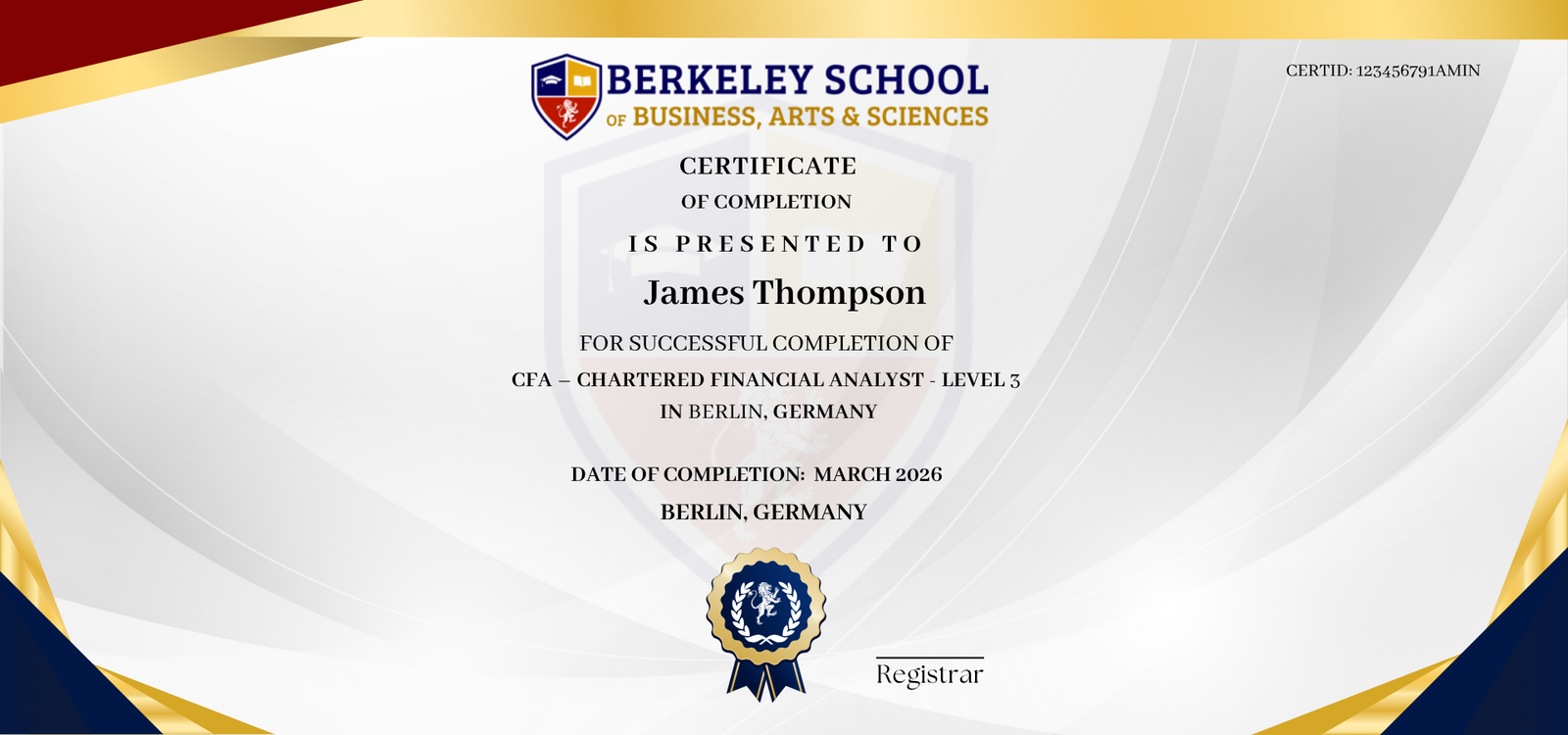
You will get a certificate of completion, which is highly reputed and accepted by employers.
Gain advanced knowledge in investment analysis, portfolio management, and financial markets.
Join a global network of investment professionals and access exclusive resources and events.
Earn a globally recognized credential that enhances your professional reputation and career opportunities.
Access high-level positions in finance and investment management with the CFA designation.
Adhere to the CFA Institute’s Code of Ethics and Standards of Professional Conduct, ensuring professionalism and integrity.