The Graduate Management Admission Test (GMAT) is a globally recognized exam designed to assess the analytical, quantitative, verbal, and writing skills of candidates applying for business and management programs. Administered by ETS, the GMAT is widely accepted by MBA and business-related master's programs worldwide. The test evaluates critical thinking, problem-solving, and data interpretation skills, ensuring candidates are prepared for the demands of graduate-level business education. With flexible online and test center options, GMAT remains a key requirement for admission to top business schools.
Offered By
Educational Testing Service (ETS)
Head office
Princeton, New Jersey, United States.
Founded In
The Educational Testing Service (ETS) was founded in 1947.
ETS's vision is to advance quality and equity in education by providing fair and reliable assessments that help individuals succeed and reach their full potential. Its mission is to enable individuals to succeed in education and their careers through high-quality assessments, research, and services that improve teaching, learning, and decision-making globally. ETS aims to help people achieve their educational and professional goals by offering innovative, accessible, and unbiased testing solutions.
Typically, there are no specific prerequisites for this certification. It is suitable for individuals interested in, Graduate Management Admission Test (GMAT) regardless of their background.
Anyone who is interested to learn about following concepts can pursue Graduate Management Admission Test (GMAT):
Analytical Writing Assessment (AWA), Critical Reasoning, Reading Comprehension, Sentence Correction, Problem Solving, Data Sufficiency, Integrated Reasoning, Quantitative Fundamentals.
Individuals with the following designations:
Professionals pursue the GMAT for admission into various courses, including Master of Business Administration (MBA), Executive MBA, Master of Finance, Master of Accounting, Business Analytics, Supply Chain Management, Human Resource Management, Marketing Management, International Business, Entrepreneurship, Healthcare Management, Data Science, Information Technology Management, Leadership & Strategy, and Economics.
The GMAT AWA section evaluates critical thinking and writing skills by requiring test-takers to analyze an argument, identify logical flaws, and construct a well-organized critique. Key strategies include structuring responses clearly, using strong reasoning, and maintaining grammatical accuracy. A well-supported, logically sound essay is essential for a high score.
The GMAT Quantitative Reasoning section assesses mathematical skills, problem-solving ability, and logical reasoning. It includes Problem-Solving and Data Sufficiency questions covering topics like arithmetic, algebra, geometry, and data interpretation. Key strategies include understanding question types, managing time efficiently, and avoiding common traps to maximize accuracy and score.
The GMAT Verbal Reasoning section evaluates reading comprehension, critical reasoning, and sentence correction skills. It tests your ability to analyze arguments, understand written material, and apply grammar rules. Key strategies include identifying logical structures, improving sentence clarity, and managing time effectively to enhance accuracy and performance.
The GMAT Integrated Reasoning section assesses your ability to analyze data from multiple sources, interpret graphs, solve two-part problems, and evaluate table data. Key strategies include identifying relevant information, managing time efficiently, and practicing with real-world data sets. Effective test-taking strategies involve understanding the adaptive format, practicing under timed conditions, and focusing on accuracy to maximize scores.
Berkeley offers expertly developed learning materials tailored to meet participants' needs, ensuring comprehensive coverage of the syllabus and optimal exam preparation.
Berkeley's methodologies equip participants with the essential knowledge and tools for both exams and future success.
Evaluates and ensure the quality of the training program and all its deliverables. This is measured through the following indicators:
The GMAT (Graduate Management Admission Test) by ETS is a standardized exam designed for admission to MBA and business programs worldwide. It assesses analytical writing, quantitative reasoning, verbal reasoning, and integrated reasoning skills. The test is computer-adaptive, available year-round, and can be taken at a test center or online.
The GMAT Focus Edition consists of three main sections:
Total Duration: 2 hours 15 minutes (excluding breaks)
The GMAT is available year-round, offering flexibility to choose a test date that aligns with your schedule.
The GMAT Focus Edition is scored on a scale of 205 to 805, with higher scores improving admission chances.
Exams are administered through the worldwide network of Pearson Vue Testing Centers. Pearson VUE offers flexible options for candidates to take exams either at physical testing centers or remotely through On VUE, its online proctoring solution.
“As a strong advocate for education and human development, I commend Berkeley for its exceptional commitment to empowering future leaders. The institution stands as a symbol of excellence, innovation, and opportunity. Students who walk its halls are nurtured with knowledge, values, and vision—qualities that contribute to building a stronger and more prosperous future for our nation.”- H.H. Shaikh Khalifa Al Hamid
Alumni Benefits
Earning a GMAT score is a pivotal step toward enrolling in MBA programs, which can significantly enhance earning potential across various countries.
United States (USA):
MBA graduates in the USA typically command high salaries, with average starting figures around $90,000. Graduates from top business schools often see starting salaries exceeding $100,000, with additional bonuses and benefits.
United Kingdom (UK):
In the UK, MBA graduates earn an average salary of approximately £54,000. However, this figure can vary significantly based on the institution and industry. For instance, graduates from Cambridge Judge Business School reported an average base salary of £91,083.
United Arab Emirates (UAE):
While specific figures for the UAE are limited, MBA graduates in the region can expect competitive salaries, particularly in sectors like finance and consulting. The UAE's strategic location and booming economy make it an attractive destination for MBA professionals.
Canada:
In Canada, MBA graduates have an average salary of around CAD 83,000. Those from top institutions may see higher figures, with salaries ranging between CAD 95,000 and 212,000 per year, depending on the industry and role.
Kingdom of Saudi Arabia (KSA):
Specific salary data for MBA graduates in KSA is limited. However, given the country's growing emphasis on economic diversification and development, MBA holders, especially in sectors like finance, consulting, and oil & gas, are likely to find lucrative opportunities.
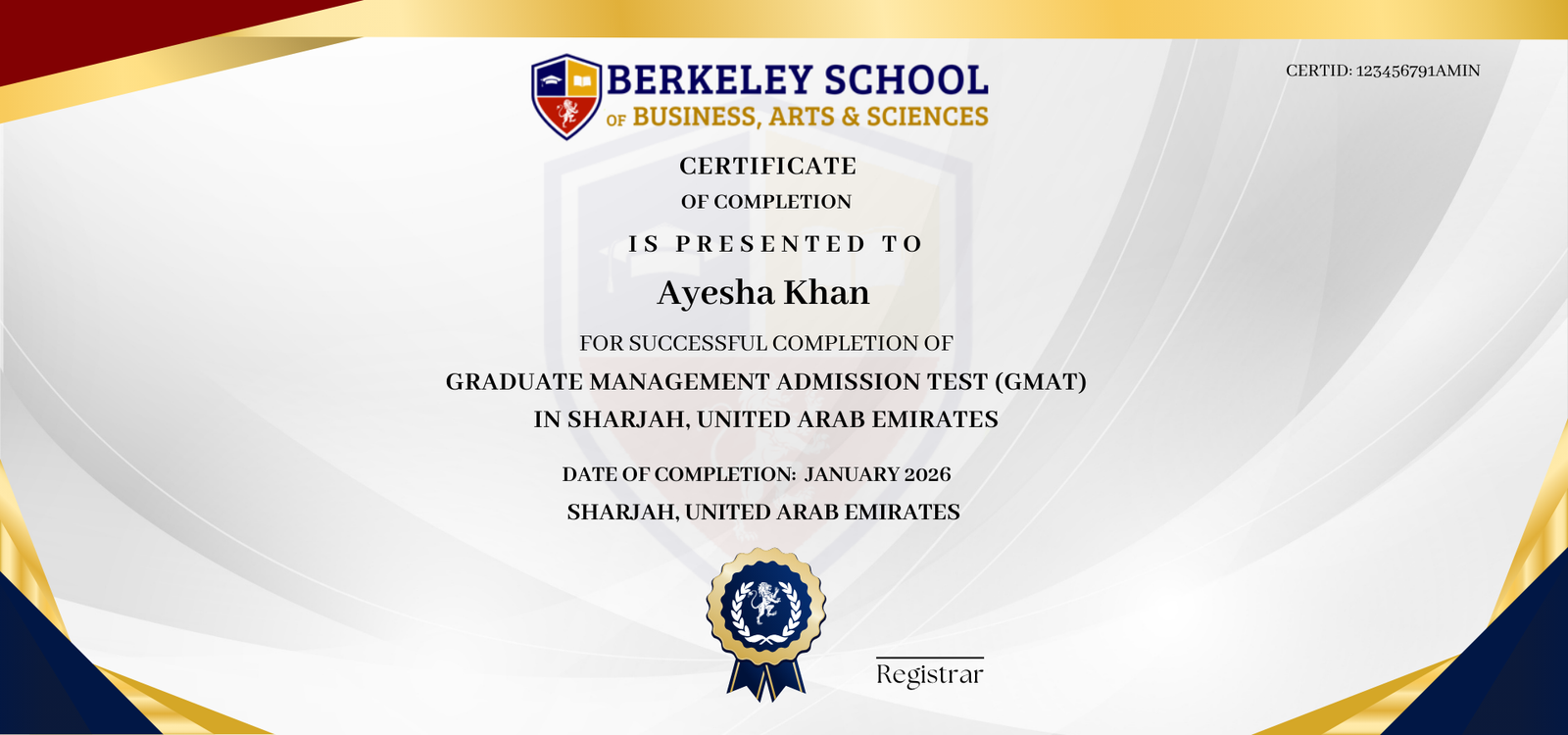
You will get a certificate of completion, which is highly reputed and accepted by employers
Technical Skills
GMAT develops quantitative analysis, data interpretation, logical reasoning, critical thinking, and problem-solving skills essential for business decision-making.
Fundamental Knowledge
GMAT assesses core skills in quantitative reasoning, verbal comprehension, analytical writing, and data interpretation, essential for business and management success.
Career Advancement
A strong GMAT score opens doors to top MBA and business programs, leading to higher salaries, leadership roles, and global career opportunities in diverse industries.
Future Trends
The GMAT is evolving with AI-driven assessments, adaptive testing, online proctoring, and increased data analysis focus, ensuring relevance in a tech-driven business world.
Industry Relevance
The GMAT is evolving with AI-driven assessments, adaptive testing, online proctoring, and increased data analysis focus, ensuring relevance in a tech-driven business world.