BERKELEY SCHOOL OF BUSINESS, ARTS & SCIENCES

GCE O Levels

The GCE O Levels is an internationally recognized secondary education qualification designed to build strong academic foundations across core subjects. It prepares students for higher education pathways such as A Levels, foundation programs, and international diploma courses while developing critical thinking, analytical, and problem-solving skills.
GCE O Levels

Overview

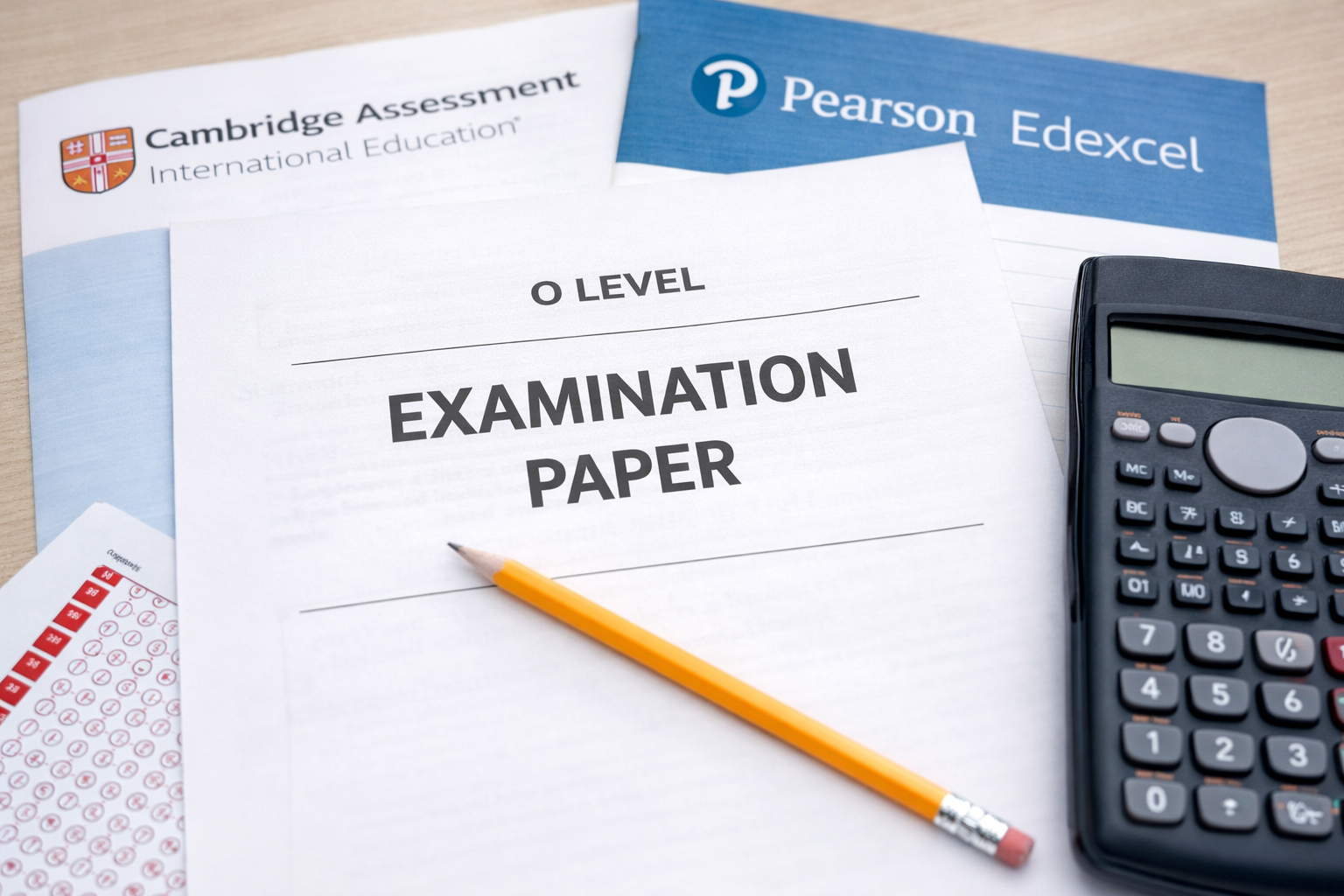
The General Certificate of Education (GCE) O Levels is a globally recognized qualification offered by leading examination boards such as Cambridge Assessment International Education (CAIE) and Pearson Edexcel. It is typically pursued by students aged 14–16 and serves as a foundation for advanced academic studies.

Card image

Offered By

Cambridge Assessment International Education and Pearson Edexcel are globally recognized examination boards that offer the General Certificate of Education (GCE) O Levels qualifications. These institutions operate under internationally accredited academic standards and provide high-quality curriculum frameworks, assessments, and certifications accepted by schools, universities, and employers worldwide.

Head office

Cambridge Assessment International Education
University of Cambridge
Shaftesbury Road, Cambridge CB2 8EA, United Kingdom
Pearson Edexcel
80 Strand, London WC2R 0RL, United Kingdom

Members

GCE O Levels is recognized and accepted by:

  • International schools and secondary education institutions worldwide
  • Universities and higher education institutions globally
  • Government education authorities
  • Professional academic and vocational institutions
  • Employers and corporate organizations internationally

Founded In

Cambridge Assessment International Education – Founded in 1858, United Kingdom Pearson Edexcel – Founded in 1996, United Kingdom Both organizations have a long-standing history of providing internationally recognized academic qualifications and assessment services.

Vision & Mission

The vision of O Levels qualification providers is to deliver high-quality, internationally recognized education that empowers students with academic excellence, critical thinking, and global competence.

Their mission is to provide reliable, fair, and rigorous academic assessment systems that prepare students for advanced education, professional careers, and lifelong learning in an increasingly competitive global environment.

What is the eligibility?

The GCE O Levels qualification is designed for secondary school students typically aged between 14 and 16 years. Students who have successfully completed lower secondary education or its equivalent are eligible to register for O Levels examinations.

O Levels is suitable for:

  • Students who have completed Grade 8 or equivalent lower secondary education
  • Students seeking an internationally recognized secondary school qualification
  • Students preparing for advanced academic programs such as A Levels, Sixth Form, or international diploma programs
  • Students planning to pursue higher education locally or internationally
  • Private candidates who meet the academic readiness requirements set by the examination board

There are no strict subject prerequisites; however, students are expected to have basic foundational knowledge relevant to the subjects they choose. Eligibility criteria may vary slightly depending on the examination board (Cambridge or Pearson Edexcel) and the educational institution providing preparation.

Who can do?

Card image

Anyone who is interested to learn about following concepts can pursue General Certificate of Education (GCE) O Levels:

Students who have completed lower secondary education (Grade 8 or equivalent), Students aged between 14 and 16 years, Students planning to pursue A Levels, Sixth Form, or international diploma programs, Students aiming for admission to international colleges and universities, Students seeking globally recognized secondary education qualifications, Private candidates preparing for international academic progression.

Individuals with the following designations:

GCE A Levels, Sixth Form Programs, International Foundation Programs, Diploma Programs, Undergraduate Degree Programs, Professional Certifications.

Course structure

The O Levels examination format varies depending on the subject and examination board but generally includes the following assessment methods:

  • Written Examinations – Subject-based theory papers conducted under supervised exam conditions
  • Practical Examinations – Required for subjects such as Physics, Chemistry, Biology, and Computer Science
  • Coursework and Assignments – Applicable for selected subjects as part of continuous assessment
  • Multiple Papers per Subject – Each subject may include two or more papers to assess different competencies

Exam Duration:

  • Each paper typically ranges from 45 minutes to 3 hours depending on the subject
  • Exams are conducted during official exam sessions, usually held in May/June and October/November

Core Academic Subjects Foundation Subjects and Academic Development

The GCE O Levels course structure is designed to provide students with comprehensive academic knowledge across core and elective subjects. The curriculum focuses on building conceptual understanding, analytical thinking, and subject mastery aligned with Cambridge and Pearson Edexcel international standards. Students study compulsory and optional subjects that prepare them for advanced education such as A Levels and university pathways.

Module 1: Core Academic Foundations

This module focuses on building essential academic foundations required for O Levels. Students develop strong skills in Mathematics and English, which are critical for understanding other subjects and for overall academic success.

  • Mathematics – Algebra, geometry, statistics, and problem-solving
  • English Language – Reading comprehension, writing skills, grammar, and communication

Module 2: Science and Analytical Skills

This module develops students’ understanding of scientific principles, experimentation, and analytical thinking through Physics, Chemistry, and Biology.

  • Physics – Motion, energy, electricity, and forces
  • Chemistry – Chemical reactions, elements, compounds, and laboratory skills
  • Biology – Living organisms, human body systems, and environment

Module 3: Technology and Business Studies

This module introduces students to Information Technology, business concepts, and digital skills essential for modern academic and professional environments.

  • Information Technology – Computer systems, software, and digital literacy
  • Business Studies – Business operations, management, and entrepreneurship basics
  • Economics – Economic principles, markets, and financial understanding

Module 4: Assessment and Examination Preparation

This module focuses on exam preparation, revision, and mock exams to ensure students are fully prepared for official O Levels examinations.

  • Mock Examinations and Practice Papers
  • Exam Techniques and Time Management
  • Performance Evaluation and Feedback

Lecture plan

Module 1: Core Academic Foundations

Lecture 1: Introduction to O Levels and Academic Skills (3) −
  • Overview of O Levels curriculum and structure
  • Study techniques and academic expectations
  • Time management and exam preparation strategies
Lecture 2: Mathematics – Numbers and Algebra (3) +
  • Number systems and operations
  • Algebraic expressions and equations
  • Problem-solving techniques
Lecture 3: Mathematics – Geometry and Statistics (3) +
  • Shapes, angles, and measurements
  • Graphs and data interpretation
  • Probability and statistical analysis
Lecture 4: English Language – Reading and Writing Skills (3) +
  • Reading comprehension techniques
  • Grammar and sentence structure
  • Paragraph and essay writing
Lecture 5: English Language – Communication Skills (3) +
  • Vocabulary development
  • Written and verbal communication
  • Exam-focused writing practice

Module 2: Science and Analytical Skills

Lecture 6: Physics – Basic Concepts and Forces (3) +
  • Motion, force, and energy
  • Units and measurements
  • Practical applications
Lecture 7: Physics – Electricity and Magnetism (3) +
  • Electrical circuits
  • Current, voltage, and resistance
  • Practical experiments
Lecture 8: Chemistry – Elements and Chemical Reactions (3) +
  • Periodic table and elements
  • Chemical reactions and equations
  • Laboratory safety and procedures
Lecture 9: Biology – Living Organisms and Human Body (3) +
  • Cell structure and functions
  • Human body systems
  • Biological processes
Lecture 10: Science Practical and Application (3) +
  • Laboratory experiments
  • Observation and analysis
  • Scientific reporting

Module 3: Technology and Business Studies

Lecture 11: Information Technology – Computer Fundamentals (3) +
  • Computer hardware and software
  • Operating systems
  • Digital literacy
Lecture 12: Information Technology – Applications and Data (3) +
  • Word processing and spreadsheets
  • Data management
  • Internet and cybersecurity basics
Lecture 13: Business Studies – Introduction to Business (3) +
  • Business types and functions
  • Entrepreneurship basics
  • Business environment
Lecture 14: Economics – Basic Economic Concepts (3) +
  • Supply and demand
  • Markets and pricing
  • Financial literacy

Module 4: Assessment and Examination Preparation

Lecture 15: Exam Preparation Techniques (3) +
  • Exam strategies and time management
  • Question analysis techniques
  • Writing effective exam answers
Lecture 16: Mock Exam Practice – Mathematics and Science (3) +
  • Practice tests
  • Performance evaluation
  • Feedback and improvement
Lecture 17: Mock Exam Practice – English and Other Subjects (3) +
  • Exam simulation
  • Writing and comprehension practice
  • Error correction and guidance
Lecture 18: Final Revision and Academic Readiness (3) +
  • Full syllabus revision
  • Exam readiness assessment
  • Final preparation guidance

Learning Methodology

The O Levels learning methodology is designed to provide students with a strong academic foundation through structured teaching, conceptual learning, and exam-focused preparation. The program combines interactive lectures, guided practice, and regular assessments to ensure students develop subject mastery, analytical thinking, and problem-solving skills. The methodology aligns with Cambridge and Pearson Edexcel international standards, preparing students for academic success and progression to A Levels and higher education.

Expert-Led Academic Lectures
Guided Practice and Skill Development
Mock Exams and Performance Evaluation

Berkeley's performance standards

The GCE O Levels qualification follows internationally recognized academic and assessment standards established by Cambridge Assessment International Education and Pearson Edexcel. These standards ensure academic excellence, subject mastery, and global recognition of the qualification. Performance and quality are evaluated through the following indicators:

  • Alignment with internationally approved curriculum frameworks and subject syllabi
  • Qualified and experienced instructors delivering structured academic preparation
  • Comprehensive coverage of subject content based on Cambridge and Pearson Edexcel standards
  • Regular assessments, assignments, and mock examinations to evaluate student readiness
  • Development of critical thinking, analytical reasoning, and problem-solving skills
  • Continuous monitoring of student progress and academic performance
  • Standardized external examinations conducted by official examination boards
  • Globally recognized certifications accepted by universities and educational institutions worldwide

These performance standards ensure students are fully prepared for official O Levels examinations and progression to advanced academic programs such as A Levels and international higher education pathways.

What is the Exam Information?

The GCE O Levels examinations are internationally recognized secondary school qualifications conducted by Cambridge Assessment International Education and Pearson Edexcel. These exams assess students’ knowledge, understanding, and application of concepts across selected academic subjects. O Levels examinations are designed to evaluate academic readiness for advanced studies such as A Levels, Sixth Form, and international higher education programs. Exams are conducted in official examination centers during scheduled examination sessions held worldwide.

Card image

Exam Format & Duration
Part/Module Exam Format Exam Duration
Core Academic Subjects
Foundation Subjects and Academic Development
The O Levels examination includes written theory papers, practical examinations (for science and IT subjects), and coursework where applicable. Each subject is assessed independently through multiple papers designed to evaluate conceptual understanding, analytical skills, and subject knowledge. Each subject examination typically consists of 1 to 3 papers, with each paper lasting between 45 minutes and 3 hours depending on the subject and examination board requirements. Exams are conducted during official Cambridge and Pearson Edexcel examination sessions.
Module 1: Core Academic Foundations Written examinations consisting of theory papers designed to assess conceptual understanding and problem-solving ability. Each subject typically includes 1–2 papers lasting between 1 hour and 2 hours.
Module 2: Science and Analytical Skills Written exams and practical examinations depending on subject requirements. Each science subject includes multiple papers ranging from 45 minutes to 2 hours.
Module 3: Technology and Business Studies Written theory papers and practical assessments (for IT). Exams typically last between 1 hour and 2 hours per subject.
Module 4: Assessment and Examination Preparation Mock exams simulating real Cambridge and Pearson Edexcel exam conditions. Mock exams follow official exam durations, ranging from 1 hour to 3 hours per paper.

Exam Dates

GCE O Levels examinations are conducted by Cambridge Assessment International Education and Pearson Edexcel during official examination sessions held globally. The main exam sessions are:

  • May / June Session
  • October / November Session

Some subjects may also be available in limited March series depending on the examination board and region. Students must register in advance through authorized schools or examination centers to appear in the exams.

Passing Criteria

The GCE O Levels grading system uses internationally recognized letter grades to evaluate student performance. Grades typically range from:

  • A* (Outstanding Performance)
  • A, B, C (Strong Performance)
  • D, E (Satisfactory Performance)
  • U (Ungraded / Fail)

A grade of C or above is generally considered a strong pass and is accepted by most colleges and universities for further academic progression. Passing criteria may vary depending on institutional and program requirements.

Exam Locations

GCE O Levels examinations are conducted at authorized examination centers worldwide. These include:

  • Registered international schools
  • Approved Cambridge and Pearson Edexcel examination centers
  • British Council authorized examination venues
  • Accredited private examination centers

Students must appear for exams at officially approved centers under supervised conditions. Exam availability depends on the subject and examination board in the student’s region.

Success Stories

Success Stories

“As a strong advocate for education and human development, I commend Berkeley for its exceptional commitment to empowering future leaders. The institution stands as a symbol of excellence, innovation, and opportunity. Students who walk its halls are nurtured with knowledge, values, and vision—qualities that contribute to building a stronger and more prosperous future for our nation.”- H.H. Shaikh Khalifa Al Hamid
Visit our Alumni

Alumni Benefits

  • Exclusive Networking Events: Access invitations to industry-leading events and thought-leadership gatherings featuring renowned speakers.
  • Monthly Updates: Stay informed with a newsletter highlighting the latest research, events, and activities from the school.
  • LinkedIn Community Access: Join the Executive Education LinkedIn group for networking and professional development opportunities.
  • Educational Discounts: Enjoy a 20% discount on open-enrollment programs and access to workshops focused on emerging trends.
  • Global Alumni Network: Connect with a diverse alumni community through the Berkeley School’s online network and engage in country and interest groups.

Is It Worth the Investment?

The GCE O Levels qualification is a critical foundation for students pursuing advanced academic and professional pathways. It is internationally recognized and serves as the first step toward higher secondary education, university admission, and global career opportunities. O Levels equips students with essential academic knowledge, analytical skills, and subject specialization required for future success.

Academic Progression Opportunities:

  • Progression to GCE A Levels or Sixth Form programs
  • Enrollment in international foundation and diploma programs
  • Qualification for college and university preparatory programs
  • Eligibility for professional and technical education pathways


Card image

Global Recognition and Academic Value:

  • Recognized by leading universities and educational institutions worldwide
  • Accepted as a standard secondary education qualification internationally
  • Provides strong preparation for undergraduate degree programs
  • Enhances eligibility for academic scholarships and merit-based admissions

Career and Professional Foundation:

  • Builds essential skills in problem-solving, critical thinking, and academic discipline
  • Prepares students for careers in fields such as Business, Engineering, Medicine, Information Technology, and Finance
  • Provides a globally accepted academic credential valued by employers and institutions

Completing O Levels establishes a strong academic base, enabling students to pursue A Levels, undergraduate degrees, and professional careers in competitive global environments.

What You Earn

What You Earn

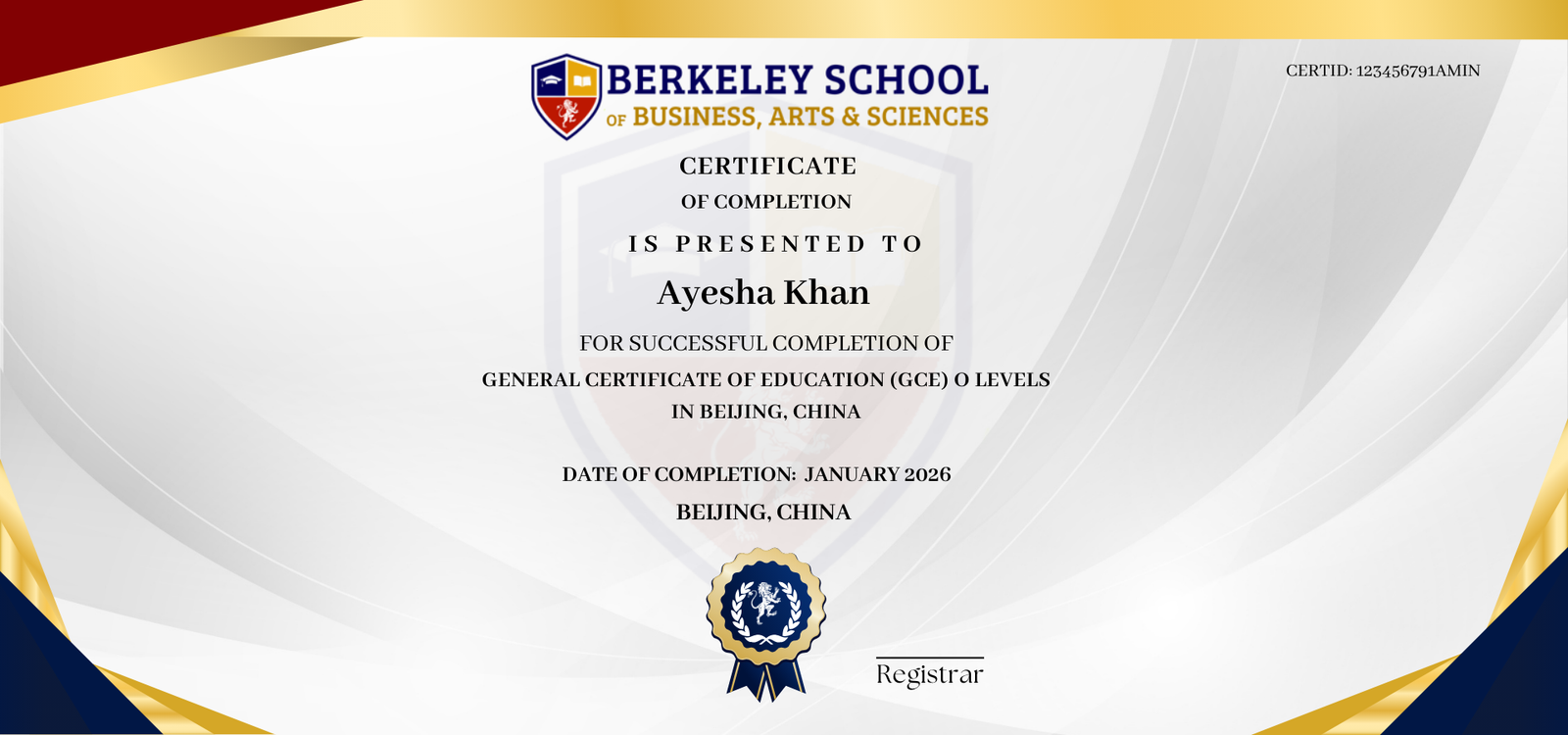
Upon successful completion of the GCE O Levels, students receive an internationally recognized secondary education certificate awarded by Cambridge Assessment International Education.

Subject Knowledge and Academic Skills

Students develop strong subject knowledge, analytical thinking, problem-solving abilities, and academic discipline across core subjects such as Mathematics, Sciences, English, and Business.

Global Recognition

The O Levels certificate is recognized by universities, educational institutions, and employers worldwide, providing students with opportunities for international education and career progression.

Career and Professional Foundation

O Levels builds essential academic and professional skills, preparing students for future careers and helping them achieve long-term educational and professional success in a competitive global environment.

Academic Qualification

O Levels provides an internationally recognized secondary school qualification that serves as a foundation for advanced academic programs such as A Levels, Sixth Form, diplomas, and international foundation courses.

Contact Us

Facebook Twitter Instagram Linkedin Youtube Tiktok
Cart

Cart (0)