BERKELEY SCHOOL OF BUSINESS, ARTS & SCIENCES

CIA – Certified Internal Auditor - Challenge Exam New York USA

CIA by IIA, is the top global certification for internal auditors, signifying expertise in audit practices, risk management, and governance.

CIA – Certified Internal Auditor - Challenge Exam New York USA

Overview

CIA Certification Information
The Certified Internal Auditor (CIA) designation, conferred by The Institute of Internal Auditors (IIA), is the premier global certification for internal audit professionals. Recognized as the standard of excellence in the field, the CIA credential demonstrates proficiency in internal audit practices. It focuses on skills essential to auditing processes, risk assessment, governance, and compliance within organizations. With a rigorous curriculum covering critical areas such as auditing processes, ethics, and business analysis, the CIA certification equips professionals to provide valuable insights and assurance to organizations.
Offered By
The Institute of Internal Auditors (IIA), the globally recognized leader in internal audit education, certification, and research.
Head Office
Lake Mary, Florida, USA.
Card image


CIA Information Section
Members
Globally, The IIA has more than 245,000 members.
Founded In
Established in 1941.
Vision & Mission
Vision: To be the global voice of the internal audit profession, advocating for excellence, professionalism, and respect in the field.
Mission: To provide dynamic leadership for the internal audit profession by promoting best practices, offering valuable certifications, advocating for the profession, and providing educational and networking resources.

What is the eligibility

You can take the CIA training program at any time and then apply for the certificate or apply once you become eligible to get the certificate. Candidates generally need a bachelor’s degree and two years of internal audit experience. However, those without a degree may still qualify with additional work experience, or if you hold relevant certifications or advanced degrees.

Arrow Right

Learn More

Who can do?


CIA Target Audience
Individuals with the following designations:
Internal Auditors, External Auditors, System Auditors, Risk Managers, Full Time & Part-Time Students, Accountants, Bankers, AP, AR Manager, Compliance Officers, Financial Analyst, Management Accountant, Finance Controllers, Quality Assurance Professional, CEO, Chairman, Inventory Managers, Budget Managers, Planning & Strategy Professionals, General Managers.
Anyone who is interested to learn about following concepts can pursue CIA – Certified Internal Auditor:
Essentials of Internal Auditing, Practice of Internal Auditing, Business Knowledge for Internal Auditing.
Card image

Course structure

The Certified Internal Auditor (CIA) certification is divided into three parts, each covering different aspects of internal auditing to provide a comprehensive skill set for auditors.

Part 1: Essentials of Internal Auditing

Tests knowledge, skills, and abilities related to the foundation of internal auditing; independence and objectivity; proficiency and due professional care; quality assurance and improvement programs; governance, risk management, and control; and fraud risk.

Part 2: Practice of Internal Auditing

Tests knowledge, skills, and abilities particularly related to managing the internal audit activity, planning the engagement, performing the engagement, and communicating engagement results and monitoring progress.

Part 3: Business Knowledge for Internal Auditing

Tests knowledge, skills, and abilities particularly related to managing the internal audit activity, planning the engagement, performing the engagement, and communicating engagement results and monitoring progress.

Lecture plan

Part 1: Essentials of Internal Auditing

Foundations of internal auditing 15% (1) +
  • Foundations of Internal Auditing
Independence and objectivity 15% (1) +
  • Independence, Objectivity, and Proficiency
Proficiency and due professional care 18% (1) +
  • Due Professional Care and Quality Assurance and Improvement Program

Part 2: Practice of Internal Auditing

Managing the internal audit activity 20% (1) +
  • Internal Audit Operations
Planning the engagement 20% (3) +
  • Assurance Engagements
  • Financial, Environmental, and Consulting Engagements
  • The Internal Audit Plan
Performing the engagement 40% (4) +
  • Engagement Planning, Risk Assessment, and Objectives
  • Engagement Procedures, Staffing, and Developing the Work Program
  • Information Gathering
  • Sampling and Statistical Quality Control
Communicating engagement results and monitoring progress 20% (2) +
  • Analysis, Evaluation, Documentation and Supervision
  • Communicating Results and Monitoring Progress

Part 3: Business Knowledge for Internal Auditing

Business acumen 35% (6) +
  • Strategic Management, Planning, and Performance Measures
  • Organizational Behavior
  • Leadership and Organizational Structure
  • Business Processes and Data Analytics
  • Project Management and Contracts
  • Databases and Applications Development
Information security 25% (2) +
  • IT Control Frameworks and Disaster Recovery
  • Information Security
Information technology 20% (1) +
  • IT Infrastructure
Financial management 20% (7) +
  • Concepts and Underlying Principles of Financial Accounting
  • Financial Accounting Elements
  • Advanced Financial Accounting Concepts
  • Financial Statement Analysis
  • Current Assets Management
  • Capital Structure, Capital Budgeting, Basic Taxation, and Transfer Pricing
  • Managerial Accounting

Learning Methodology

Learning Materials

Berkeley offers expertly developed learning materials tailored to meet participants' needs, ensuring comprehensive coverage of the syllabus and optimal exam preparation.

  • Tailored Material: Guides are designed to cover the entire syllabus, offering full preparation and deep understanding.
  • In-Depth Content: Unlike superficial outlines, our materials provide fully developed theories and concepts, equipping participants with complete knowledge.
  • Strategic Study: We help participants prioritize study time by indicating the weight of each topic, allowing efficient focus on crucial areas.
  • Difficulty Levels: Topics are labeled as "Awareness" or "Proficiency," guiding participants to allocate time based on the required depth of knowledge.
  • Comprehensive Coverage: Our materials include detailed theory and a glossary of technical terms to clarify complex concepts.
  • Effective Learning Techniques: Visual aids and memorization techniques ensure long-lasting retention, helping candidates succeed.

Berkeley’s methodologies equip participants with the essential knowledge and tools for both exams and future success.

Lectures
Lectures
Practice Session
Practice Session
Mock Examination
Mock Examination

Berkeley's performance standards

Training Quality Indicators

Evaluates and ensure the quality of the training program and all its deliverables. This is measured through the following indicators:

  • Instructors' experience and style in presenting and explaining topics.
  • Variety and balance of teaching methods (such as discussions, case studies, mock exams, and videos) used in the course to ensure retention and to match the learning objectives.
  • Level of interactivity.
  • Feedback from program participants.
  • Full compliance with Institute standards and guidelines for preparation and study requirements and methodology.
  • Progress reports from the training program provider.
Arrow Right

Learn More

What are the Exam Information?

CIA Exam Format
Exam Format & Duration
* Offered as a CBT (Computer Based Testing)
Part/Module Exam Format Exam Duration
Part 1: Essentials of Internal Auditing 125 Multiple Choice Questions 2.5 Hours
Part 2: Practice of Internal Auditing 100 Multiple Choice Questions 2 Hours
Part 3: Business Knowledge for Internal Auditing 100 Multiple Choice Questions 2 Hours
EXAM DATES
Candidates can sit for the CIA Exam throughout the year.
Card image

CIA Passing Criteria
Passing Criteria
CIA Exam Passing Score: Out of the range of 250 to 750, the passing score is 600.
EXAM LOCATIONS
Exams are administered through the worldwide network of Pearson Vue Testing Centers. Pearson VUE offers flexible options for candidates to take exams either at physical testing centers or remotely through OnVUE, its online proctoring solution.
Success Stories

Success Stories

“As a strong advocate for education and human development, I commend Berkeley for its exceptional commitment to empowering future leaders. The institution stands as a symbol of excellence, innovation, and opportunity. Students who walk its halls are nurtured with knowledge, values, and vision—qualities that contribute to building a stronger and more prosperous future for our nation.”- H.H. Shaikh Khalifa Al Hamid

Visit Our Alumni

Alumni Benefits
Alumni Benefits
  • Exclusive Networking Events: Access invitations to industry-leading events and thought-leadership gatherings featuring renowned speakers.
  • Monthly Updates: Stay informed with a newsletter highlighting the latest research, events, and activities from the school.
  • LinkedIn Community Access: Join the Executive Education LinkedIn group for networking and professional development opportunities.
  • Educational Discounts: Enjoy a 20% discount on open-enrollment programs and access to workshops focused on emerging trends.
  • Global Alumni Network: Connect with a diverse alumni community through the Berkeley School’s online network and engage in country and interest groups.

Certified Internal Auditor - CIA Salary: Is It Worth the Investment?

CIA Salary Comparison

Here’s a concise breakdown of CIA-certified salaries by region compared to non-certified auditors:

  • North America: CIAs earn around 25% more than non-CIAs, with salaries ranging from $80,000 to $120,000, driven by high demand in finance and compliance roles.
  • Middle East (UAE, Saudi Arabia): In financial centers like Dubai and Riyadh, CIAs earn 15–20% more than non-CIAs, with annual salaries between $70,000 and $100,000 due to the growing focus on compliance and governance.
  • Europe: CIAs see about a 20% salary premium, especially in cities like London and Frankfurt, with typical salaries from €60,000 to €90,000 reflecting strong demand for regulatory expertise.
  • Asia (India, Singapore): Certified auditors in Asia earn up to 20% more. For example, in Singapore, CIAs can earn SGD 70,000–100,000, while in India, CIAs may reach INR 1,200,000, reflecting the need for global standards and auditing.
  • Africa and Latin America: CIAs in these regions generally earn 10–15% more than non-CIAs. In developing markets, certified auditors are valued for strengthening internal controls and managing organizational risk.
Card image

What is CIA Challenge Exam?

CIA Challenge Exam

Acquire the Certified Internal Auditor (CIA) designation through the CIA Challenge Exam. This streamlined procedure enables you to obtain the CIA designation by successfully clearing one examination, which solely focuses on content not included in your CPA, CV, ACCA or CISA exam. The CIA challenge exam condenses the content of the traditional three-part CIA exam into a single, comprehensive exam. It covers essential topics like internal auditing fundamentals, risk management, governance, and fraud controls. It allows eligible professionals to bypass the need to take all three parts of the standard CIA exam. This significantly reduces the time and effort required to earn the certification.

Key Features of the CIA Challenge Exam:
Eligibility:
  • The exam is available to members of recognized accounting bodies such as CISA, ACCA, CA, CPA, or similar qualifications.
  • Candidates typically need to have substantial professional experience in internal auditing, accounting, or finance.
Exam Format:
  • 150 MCQs (Computer Based Testing)
  • Exam Duration: 3 Hours
Exam Dates:
  • Application window: April – September
  • First Attempt Testing Windows: June, August, November, or February
  • Once your application is approved, please note you have 180 days to register, schedule, and sit for the exam.
Arrow Right

Learn More

What You Earn

What You Earn

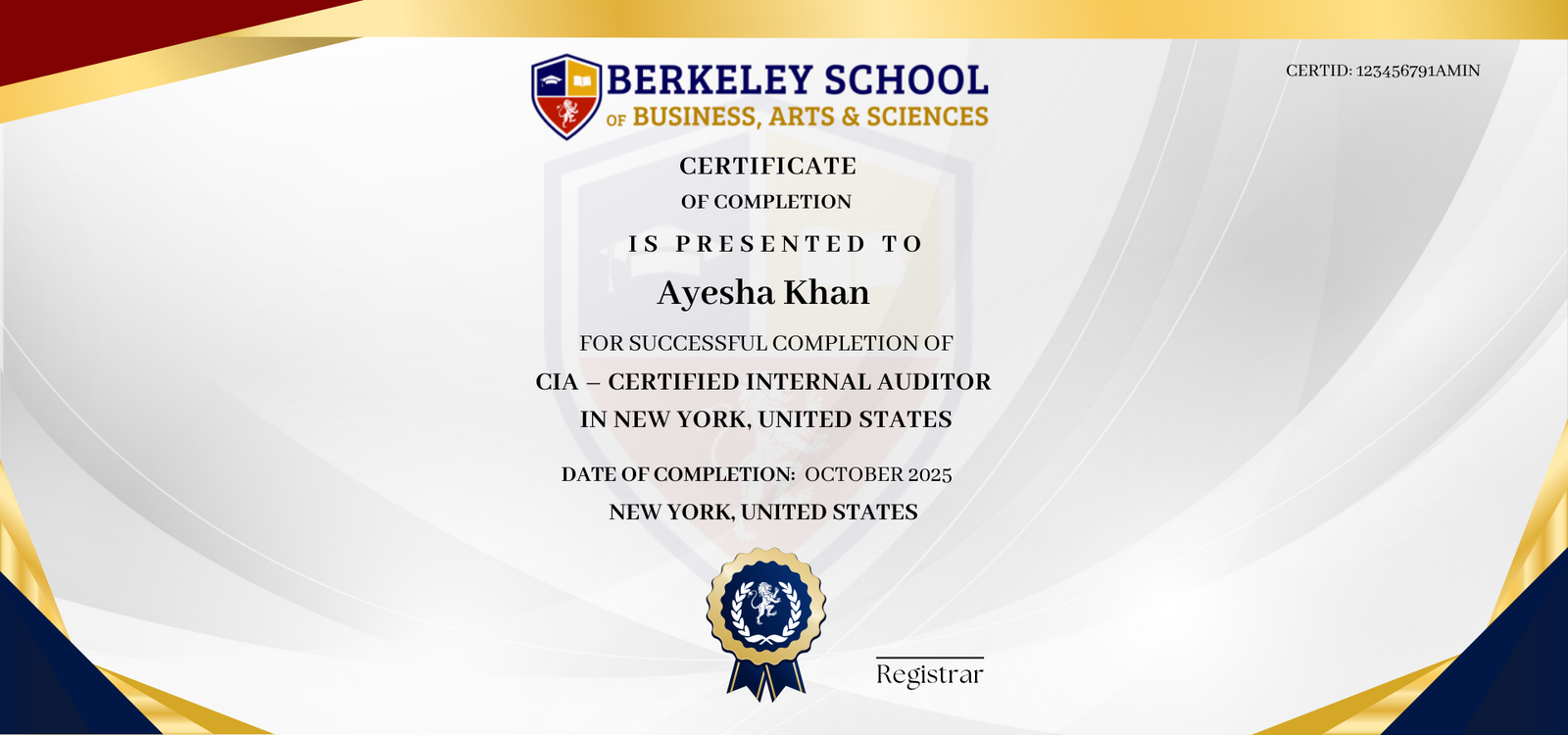
You will get a certificate of completion, which is highly reputed and accepted by employers.

Global Recognition
Earn a globally recognized certification that enhances your credibility in the internal audit profession.
Enhanced Skills
Gain advanced knowledge in auditing, risk management, and governance to improve your effectiveness.
Career Advancement
Open doors to senior-level roles and increase your earning potential with the CIA designation.
Professional Network
Join a global community of internal auditors and expand your professional network.
Continuous Learning
Access ongoing educational resources to stay updated on industry trends and best practices.

Contact Us

Facebook Twitter Instagram Linkedin Youtube Tiktok
Cart

Cart (0)