BERKELEY SCHOOL OF BUSINESS, ARTS & SCIENCES

Certified CFO Program

The certified CFO program aims at transforming senior executives into thoughtful business & financial leaders. Berkeley’s world-class, comprehensive general management programs are designed to accelerate your effectiveness not as a manager but as a leader, by value addition in strategic and management levels.

Certified CFO Program

Overview

The Certified CFO Training Program is a specialized course designed to develop the advanced skills and knowledge required for chief financial officers. It focuses on financial strategy, corporate governance, risk management, and strategic decision-making, equipping CFOs to lead financial operations effectively and drive organizational success. Delivered by world-class faculty, the program emphasizes real-world applications, leadership, and innovation to prepare participants to become exceptional business and financial leaders. Graduates gain expertise in financial planning, analysis, control, decision support, and professional ethics—skills highly valued globally. The program combines functional understanding with a holistic approach, enabling leaders to handle financial complexities and drive organizational change at a strategic level.

Card image

Offered by

Berkeley School of Business, Arts & Sciences

What are the Objectives?

  • Provide strategic and managerial support to candidates.
  • Improve vision, thoughts, decision-making, & ability to forecast and predict.
  • Develop personality and ability to question and find reasoning and leadership.

Vision & Mission

The Certified CFO Training Program aims to equip financial leaders with advanced skills in strategic financial management, risk assessment, and organizational leadership. Our mission is to develop top-tier CFOs who can drive financial strategy, foster organizational growth, and uphold the highest standards of financial integrity.

What is the eligibility?

Educational Background:

  • No prior qualifications are required. Anyone in finance, accounting, economics, business administration, or a related field.

Professional Experience:

  • Mid to senior-level professionals with 5-10+ years of experience in finance, accounting, or leadership roles.
  • Current or aspiring CEOs, finance directors, or senior finance professionals seeking advanced leadership skills.

Skills and Knowledge:

  • Strong foundational knowledge in financial management, strategic planning, and corporate governance.

Who can do?

Card image

Anyone who is interested to learn about following concepts can pursue Certified CFO Program:

Strategic Financial Leadership, Innovation, Entrepreneurship and Business Environment, Strategic Auditing and Attestation, Financial Planning and Reporting, Digital Information System and CFO's Succession Planning.

Individuals with the following designations:

Chief Financial Officer (CFO), Finance Director, Senior Financial Strategist, Financial Consultant, Financial Manager, Head of Finance, Accounting Manager, Corporate Treasurer, Senior Financial Analyst, Auditors and Risk Managers, Business Owners/Entrepreneurs, Management Accountants, Consultants.

Course structure

This structure delivers a comprehensive understanding of the roles and responsibilities of a Certified CFO across core financial and strategic domains, ensuring that each day emphasizes a critical aspect of financial leadership, corporate governance, and performance management.

▶ Duration                                                6 Months
▶ Lectures                                                36 Hours
▶ Self-Reading & Assignments              120 Hours


Module 1: CFO's Strategic Financial Leadership

Entrepreneurship involves identifying opportunities, creating innovative solutions, and driving economic growth. It matters by fostering innovation, job creation, and competitiveness. Key elements for entrepreneurial success include selling a compelling vision, designing a portfolio of experiments to create traction, and modeling growth through key metrics. Entrepreneurs must understand funding cycles and effectively raise capital to scale their businesses. Establishing a strong organizational culture is crucial for sustaining long-term growth, aligning teams with the company's mission, and fostering innovation and collaboration.

Module 2: CFO's Innovation, Entrepreneurship and Business Environment

Corporate innovation is key to maintaining competitiveness and driving long-term growth. Overcoming barriers and fostering a culture of innovation within large organizations is essential, along with understanding corporate governance frameworks like internal controls and risk management. Economic concepts, financial management, and IT risk awareness are crucial for strategic decision-making and growth. Operations management, focused on performance measures and cost efficiency, ensures continued success and organizational effectiveness.

Module 3: CFO's Strategic Auditing and Attestation

This content outlines key aspects of auditing, focusing on ethics and professional conduct, including independence, documentation, and communication. Risk assessment covers engagement planning, understanding the entity's environment and internal controls, fraud risk, and using others’ work. Evidence gathering emphasizes obtaining sufficient evidence through sampling and addressing misstatements or deficiencies. Finally, reporting involves producing various audit and compliance reports while considering other reporting requirements.

Module 4: CFO's Financial Planning and Reporting

This content covers financial reporting for both business and non-business entities, focusing on general-purpose financial statements, public company reporting, and employee benefit plans. It includes key accounts like cash, receivables, inventory, and debt, as well as transactions such as business combinations, foreign currency, leases, and fair value measurements. Additionally, it highlights state and local government reporting, including the comprehensive annual financial report (CAFR) and financial statement presentation for government entities.

Module 5: CFO's Digital Information System

This content strengthens CFO digital information systems by integrating big data technologies, data visualization, and AI-driven analytics to improve financial reporting and operational intelligence. Machine learning and automated reasoning enhance forecasting accuracy, risk assessment, and decision support. Advanced data processing and visualization tools enable real-time financial monitoring, system flexibility, and scalable digital transformation across finance operations.

Module 6: CFO’s Succession Planning

This content supports CFO succession planning by building analytical leadership capabilities and strategic decision-making skills. It emphasizes data-driven forecasting, performance measurement, and simulation techniques to evaluate financial leadership readiness. Pattern recognition and AI-based insights enable identification of high-potential talent, while structured development strategies ensure smooth knowledge transfer, continuity of financial governance, and long-term organizational stability.

Lecture plan

DAY 1 – Strategic Financial Leadership & Entrepreneurial Finance (2 Hours)

Entrepreneurial Finance Foundations (4) +
  • ✔ Role of CFO in value creation and growth
  • ✔ Selling the financial vision to investors and stakeholders
  • ✔ Traction modeling and momentum forecasting
  • ✔ Funding cycles and capital raising strategies
Financial Leadership & Culture (1) +
  • ✔ CFO’s role in organizational culture
Default Sub Heading Title (3) +
  • ✔ Financial governance and accountability
  • ✔ Performance transparency frameworks
  • ✔ Ethics in financial leadership

DAY 2 – Innovation, Governance & Business Environment (2 Hours)

Corporate Innovation & Financial Strategy (3) +
  • ✔ Financing innovation initiatives
  • ✔ Overcoming innovation investment barriers
  • ✔ Self-disruption strategies and portfolio optimization
Governance, ERM & Economic Analysis (3) +
  • ✔ Internal controls and ERM frameworks
  • ✔ Regulatory compliance overview
  • ✔ Economic cycles and market risk analysis

DAY 3 – Financial Management, IT Risk & Operations Performance (2 Hours)

Financial & Capital Management (3) +
  • ✔ Capital structure optimization
  • ✔ Working capital management
  • ✔ Valuation and investment decision models
IT Risk & Operational Performance (3) +
  • ✔ Financial systems technology risks
  • ✔ Cybersecurity controls
  • ✔ Cost accounting and performance KPIs

DAY 4 – Ethics, Professional Responsibility & Audit Planning (2 Hours)

Financial & Capital Management (3) +
  • ✔ Capital structure optimization
  • ✔ Working capital management
  • ✔ Valuation and investment decision models
IT Risk & Operational Performance (3) +
  • ✔ Financial systems technology risks
  • ✔ Cybersecurity controls
  • ✔ Cost accounting and performance KPIs

DAY 5 – Audit Evidence, Assurance & Reporting (2 Hours)

Audit Evidence & Assurance (3) +
  • ✔ Evidence sufficiency principles
  • ✔ Sampling methods
  • ✔ Substantive audit procedures
Audit Reporting & Compliance (3) +
  • ✔ Audit and attestation reports
  • ✔ Compliance reporting
  • ✔ Stakeholder communication

DAY 6 – Financial Reporting Standards & Statement Analysis (2 Hours)

Financial Reporting Frameworks (3) +
  • ✔ Conceptual framework
  • ✔ Standard-setting bodies
  • ✔ Public company reporting requirements
Core Financial Statements (3) +
  • ✔ Balance sheet, income statement, cash flow analysis
  • ✔ Revenue recognition principles
  • ✔ Asset and liability measurement

DAY 7 – Advanced Accounting Transactions & IFRS Alignment (2 Hours)

Complex Financial Transactions (3) +
  • ✔ Business combinations
  • ✔ Leases and foreign currency transactions
  • ✔ Hedge accounting and contingencies
IFRS vs US GAAP (3) +
  • ✔ Recognition and measurement differences
  • ✔ Disclosure requirements
  • ✔ Cross-border reporting challenges

DAY 8 – Government & Public Sector Financial Reporting (2 Hours)

Complex Financial Transactions (3) +
  • ✔ Business combinations
  • ✔ Leases and foreign currency transactions
  • ✔ Hedge accounting and contingencies
IFRS vs US GAAP (3) +
  • ✔ Recognition and measurement differences
  • ✔ Disclosure requirements
  • ✔ Cross-border reporting challenges

DAY 9 – Data Science & Financial Analytics (2 Hours)

Financial Data Technologies (3) +
  • ✔ Financial databases and warehousing
  • ✔ Big data platforms
  • ✔ Visualization dashboards
Statistical Finance & Forecasting (3) +
  • ✔ Predictive analytics
  • ✔ Financial risk modeling
  • ✔ Forecasting techniques

DAY 10 – AI, Machine Learning & Intelligent Finance Systems (2 Hours)

AI Applications in Finance (3) +
  • ✔ Financial automation
  • ✔ Credit scoring systems
  • ✔ Fraud detection models
Advanced Analytics (3) +
  • ✔ Neural networks
  • ✔ Pattern recognition
  • ✔ Deep learning finance use cases

DAY 11 – Digital Governance, Cybersecurity & Financial Controls (2 Hours)

Digital Governance & Compliance (3) +
  • ✔ Data governance frameworks
  • ✔ Privacy and regulatory compliance
  • ✔ CFO accountability in digital finance
Cyber Risk & Internal Controls (3) +
  • ✔ Cybersecurity threats
  • ✔ Technology control systems
  • ✔ Financial system protection

DAY 12 – Succession Planning, Leadership Development & Strategic Continuity (2 Hours)

CFO Succession Planning (3) +
  • ✔ Leadership pipeline development
  • ✔ Identifying critical finance roles
  • ✔ Knowledge transfer strategies
Strategic Continuity & Performance Monitoring (3) +
  • ✔ Measuring leadership impact
  • ✔ Progress tracking
  • ✔ Organizational resilience planning

Berkeley's performance standards

Evaluates and ensure the quality of the training program and all its deliverables. This is measured through the following indicators:

  • ► Instructors’ experience and style in presenting and explaining topics.
  • ► Variety and balance of teaching methods (such as discussions, case studies, mock exams and videos) used in the course to ensure retention and to match the learning objectives.
  • ► Level of interactivity.
  • ► Feedback from program participants.
  • ► Full compliance with Institute standards and guidelines for preparation and study requirements and methodology.
  • ► Progress reports from the training program provider.
Self-Reading (120 Hours)

Self-Reading (120 Hours)

Self-reading in the Certified CEO Program helps participants build knowledge in leadership, strategy, and decision-making through independent study, fostering critical thinking and a proactive mindset for executive success.

Assignments (250 Hours)

Assignments (250 Hours)

Apply theoretical knowledge to real-world scenarios, enabling participants to develop practical skills in leadership, strategy, and decision-making. They focus on analyzing business challenges, crafting solutions, and demonstrating critical thinking and problem-solving abilities. These tasks help participants deepen their understanding of key concepts while preparing them for executive-level responsibilities.

Success Stories

Success Stories

“As a strong advocate for education and human development, I commend Berkeley for its exceptional commitment to empowering future leaders. The institution stands as a symbol of excellence, innovation, and opportunity. Students who walk its halls are nurtured with knowledge, values, and vision—qualities that contribute to building a stronger and more prosperous future for our nation.”- H.H. Shaikh Khalifa Al Hamid
Visit our Alumni

Alumni Benefits

  • ► Exclusive Networking Events: Access invitations to industry-leading events and thought-leadership gatherings featuring renowned speakers.
  • ► Monthly Updates: Stay informed with a newsletter highlighting the latest research, events, and activities from the school.
  • ► LinkedIn Community Access: Join the Executive Education LinkedIn group for networking and professional development opportunities.
  • ► Educational Discounts: Enjoy a 20% discount on open-enrollment programs and access to workshops focused on emerging trends.
  • ► Global Alumni Network: Connect with a diverse alumni community through the Berkeley School’s online network and engage in country and interest groups.

Certified CFO Training: Is It Worth the Investment?

  • ► Enhanced Credentials: Certification adds credibility and demonstrates expertise in financial strategy, governance, and leadership.
  • ► Path to CFO Role: Equips aspiring CFOs and senior finance professionals with the skills to transition into executive roles.
  • ► Global Recognition: This program is recognized worldwide, opening opportunities across industries and geographies.
  • ► Strategic Knowledge: Covers advanced topics such as risk management, financial strategy, and decision-making.
  • ► Leadership Focus: Prepares participants to lead change, foster innovation, and drive organizational growth.
  • ► Real-World Applications: Practical insights from case studies and experienced faculty enhance problem-solving abilities.
  • ► Increased Earning Potential: CFOs and senior finance leaders often earn significantly higher salaries. Certification can position you for these roles.

If you are an ambitious finance professional seeking to elevate your career, expand your expertise, and position yourself for leadership roles, the Certified CFO Program is a worthwhile investment.

Card image

Progression Route: After the completion of Certified CFO

Successful completion of the Certified CFO program enables you to a Postgraduate & master’s degree top-up from world-class British Universities.

Key Features:

  • ► 100% distance learning.
  • ► Accepted and recognized all over the world.
  • ► Duration 6 to 12 months depending upon the course.
  • ► Cost-Effective.
  • ► Opportunity to visit the UK for a study tour.
  • ► Immigration options to Canada & Australia.
  • ► Job opportunities across the globe with higher salaries.
What you earn

What you earn

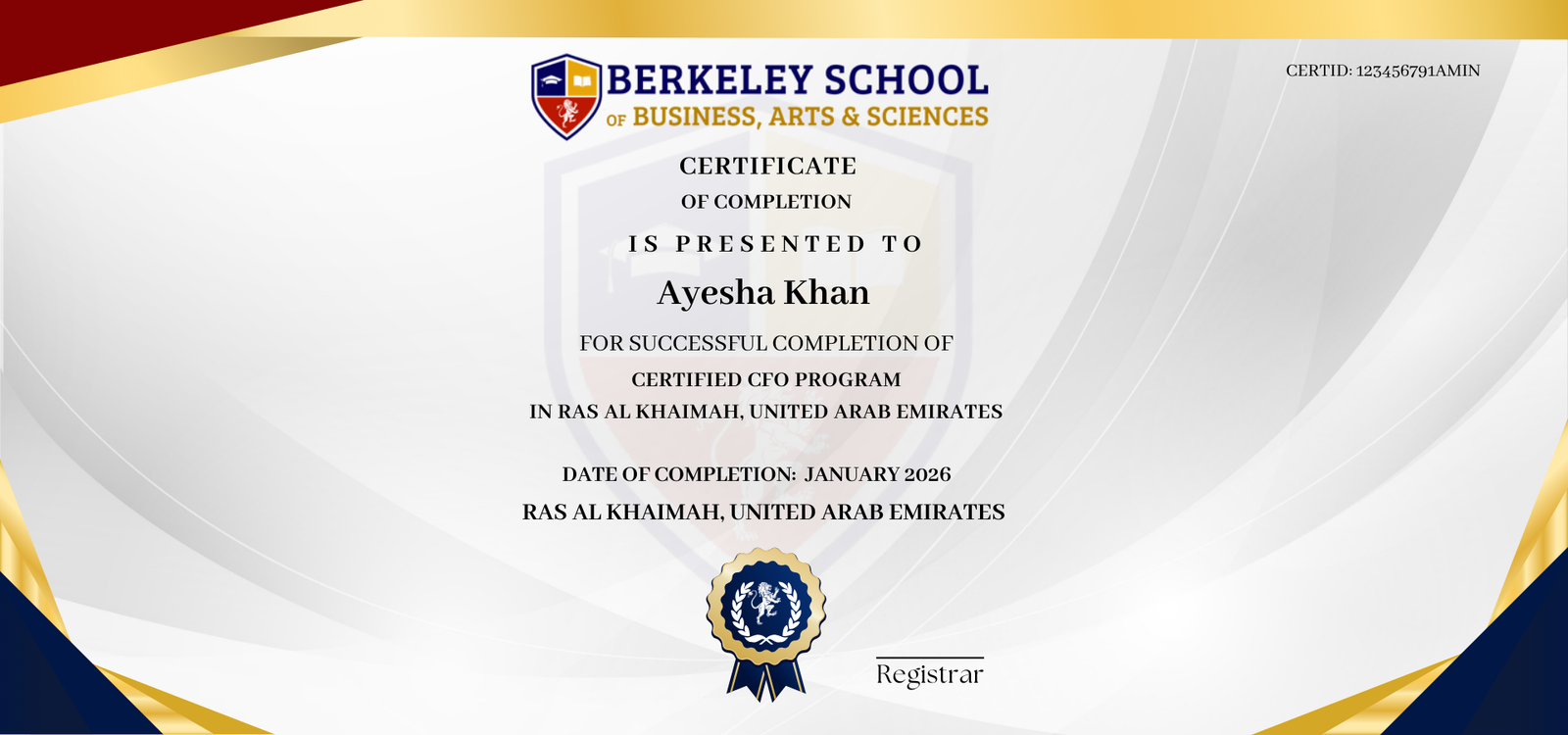
You will get a certificate of completion, which is highly reputed and accepted by employers.

Advanced Skills
Develop expertise in strategic financial management, risk analysis, and corporate finance.

Leadership Development
Enhance leadership and decision-making abilities tailored for CFO roles.

Industry Recognition
Gain a credential recognized for its focus on advanced financial and executive skills.

Career Advancement
Open doors to senior executive positions and enhance your influence within organizations.

Professional Networking
Connect with other CFOs and financial leaders, expanding your professional network and opportunities.

Contact Us

Facebook Twitter Instagram Linkedin Youtube Tiktok
Cart

Cart (0)