BERKELEY SCHOOL OF BUSINESS, ARTS & SCIENCES

Certified CEO Program

The Certified CEO Training Program equips senior executives with essential skills for leading at the highest level. It covers strategic leadership, financial management, and organizational governance, focusing on advanced topics like risk management and global strategies. Participants will enhance their decision-making and communication skills through practical exercises and case studies, preparing them for effective CEO roles.

Certified CEO Program

Overview

The Certified CEO Training Program is an advanced course designed to prepare senior executives for the role of Chief Executive Officer by enhancing their strategic leadership and management capabilities. This program covers a wide range of topics crucial for effective CEO performance, including corporate strategy development, financial management, organizational behavior, and governance. Participants will explore advanced concepts such as risk management, mergers and acquisitions, and global business strategies. The course also emphasizes leadership skills, including decision-making, stakeholder communication, and change management. Through case studies, simulations, and interactive workshops, learners will gain practical insights and hands-on experience in steering an organization toward long-term success and sustainability.


Offered by

Berkeley School of Business, Arts & Sciences


What are the Objectives?
  • Provide strategic and managerial support to candidates.
  • Improve vision, thoughts, decision-making, & ability to forecast and predict.
  • Develop personality and ability to question and find reasoning and leadership.

Vision & Mission

The Certified CEO Program aims to develop visionary, ethical leaders who can drive organizational success and innovation. Its mission is to equip senior executives with the strategic, governance, and leadership skills needed to excel as CEOs and make informed decisions that foster long-term growth and sustainability.

Card image

What is the eligibility?

Educational Background:

  • No prior qualifications are required. Anyone in business administration, managerial, or any other field.

Professional Experience:

  • Mid to senior-level professionals with 5–10+ years of experience in executive or senior management positions.
  • Current or aspiring CEOs, directors, or senior managerial professionals seeking advanced leadership skills.

Skills and Knowledge:

  • Strong leadership and decision-making abilities are essential, as the program prepares individuals for top-level executive roles.

Who can do?

Card image


Anyone who is interested to learn about following concepts can pursue Certified CEO Program:

Strategic Direction & Planning, Strategic Marketing Management, Financial Planning and Analysis, Organisational Change Strategies & Human Capital Leadership, Digital Information and Data Analysis Management, Audits, Risks, Frauds & Assurance.


Individuals with the following designations:

Chief Financial Officers (CFOs), Chief Operating Officers (COOs), Chief Strategy Officer, Business Leader, Senior executives, Business leaders, Executive Director, General Managers, Aspiring CEOs, Vice President, Executives in Strategy, Entrepreneurs, Business Owners, Executives in Corporate Development.

Course structure

This structure provides a comprehensive understanding of the roles and responsibilities of a CEO across various strategic areas, ensuring that each day focuses on a key aspect of strategic management and leadership.

▶ Duration
6 Months
▶ Lectures
36 Hours
▶ Self-Reading & Assignments
120 Hours

Module 1: CEO’s Strategic Direction & Planning

This module equips leaders with the ability to design, evaluate, and execute long-term strategic plans that align with organizational goals. It explores strategic analysis frameworks, risk assessment, and stakeholder mapping while sharpening decision-making skills needed to set a clear strategic direction. CEOs learn how to position their organizations for sustainable growth in an evolving global landscape.

Module 2: CEO’s Strategic Marketing Management

This module focuses on developing market-driven strategies that build strong brands, enhance customer value, and drive competitive advantage. It covers market research, consumer insights, global marketing trends, and digital engagement tools. CEOs gain the ability to lead effective marketing strategies that strengthen market presence and support long-term business objectives.

Module 3: CEO’s Financial Planning and Analysis

This module provides a comprehensive understanding of financial leadership, enabling CEOs to interpret financial statements, manage budgets, assess investments, and drive value creation. It simplifies key accounting concepts, costing methods, performance metrics, and data-driven financial decision-making. CEOs develop the financial insight needed to steer organizational performance with confidence.

Module 4: CEO’s Organisational Change Strategies & Human Capital Leadership

This module prepares CEOs to lead transformation by understanding organizational behavior, culture, and the human dynamics of change. It covers modern change models, communication strategies, and performance management systems. Leaders learn how to build high-performing teams, enhance employee engagement, and create a culture that supports agility and continuous improvement.

Module 5: CEO’s Digital Information and Data Analysis Management

This module explores the digital ecosystem shaping today’s business environment, including blockchain, IoT, digital payments, and data governance. CEOs learn how to leverage technology, analytics, and knowledge management to enhance efficiency and innovation. The module also emphasizes data ethics, cybersecurity, and digital transformation as strategic drivers of organizational success.

Module 6: CEO’s Audits, Risks, Frauds & Assurance

This module strengthens the CEO’s ability to oversee governance, compliance, and organizational integrity. It covers risk assessment, internal controls, fraud prevention, and the roles of internal and external audits. CEOs gain clarity on assurance reporting, ethical responsibilities, and how to maintain transparency while protecting the organization from financial, operational, and regulatory risks.

Lecture plan

DAY 1 – Strategic Role of the CEO & Foundations of Strategic Direction (3 Hours)

CEO’s role in setting organizational purpose and long-term direction (4) +
✔ Evaluate each component of the strategic plan and analyze influencing factors.
✔ Structured evaluation of the organization's strategic position and change drivers.
✔ Develop and justify strategic options aligned with aims, objectives, and stakeholder expectations.
✔ Assess risks and components of a strategic plan with continuous monitoring and review.
Strategic thinking vs. operational thinking (2) +
✔ Use frameworks like Medelow, Johnson, Whittington, and Scholes.
✔ Employ POSIWID, alternative options, and various tools to achieve strategic goals.
Vision, mission, values and strategic alignment (3) +
✔ Components of a strategic marketing plan, including marketing mix, research, and methodologies.
✔ Incorporate international marketing planning, diffusion of innovation, product life cycle, and experience curve.
✔ Address risks within marketing plans and integrate brand management, global brands, and advertising regulations.
Understanding business ecosystems, competition, and market forces (3) +
✔ Analyze behaviors, attitudes, and loyalty measures.
✔ Enhance customer service and adapt strategies to digital and global marketing trends.
✔ Apply globalization theories and case studies in practice.
Introduction to strategic planning frameworks (SWOT, PESTLE, Porter’s Five Forces) (1) +
✔ Ensure compliance with marketing and advertising regulations, including global and child-focused advertising standards.

DAY 2 – Strategic Analysis, Risk Evaluation & Strategic Option Development (3 Hours)

Evaluating the organization’s current strategic position (5) +
✔ Basic accounting concepts (e.g., profit, cash, matching)
✔ Difference between capital & revenue, sources of financial data
✔ Financial analysis
✔ Return on investment calculations
✔ The role of depreciation
Internal and external risk assessment for CEOs (5) +
✔ Budgeting and cash flows
✔ Costing methods and overhead allocations
✔ Cost / profit centres and allocating costs
✔ Analysis of financial data, cost-benefit analysis
✔ Lean methods and lean accounting
Medelow’s Matrix (stakeholder mapping) (2) +
✔ The difference between data and information
✔ Sources of data and information
POSIWID and organizational behavior interpretation +
Developing strategic options and selecting strategic priorities +

DAY 3 – Strategic Marketing Management for CEOs (3 Hours)

Strategic marketing planning and leadership decision making (13) +
✔ Setting scope and boundaries
✔ Perspectives and relationships
✔ Problem structuring methods (PSMs)
✔ Importance of organisational change
✔ Organisational change and the individual
✔ A 20-year look at business and organisational change
✔ Organisational change and organisational theory
✔ Culture, power, politics, and change
✔ Approaches to organisational change – traditional models
✔ Change solutions vs. change options
✔ Change as an emergent, tropic, rhizomatic, and spontaneous process
✔ Emergence and power of social media as a change process
✔ Organisational change and organisational choice
Market research methodologies and customer intelligence (3) +
✔ Organisational structures
✔ Organisational maturity and leadership styles
✔ Change communications and communication strategies
Global marketing strategies, segmentation, and targeting (20) +
✔ Setting the context for team performance
✔ IMPAQ performance management approach
✔ Performance management system & performance appraisal context
✔ Elements of the change framework
✔ Adair – action centres leadership
✔ Scope & objectives of change
✔ Motivation models and concepts
✔ Tuckman – stages of team development
✔ Latham and Locke 1990
✔ Performance management cycle
✔ Aligning team goals with organisational strategy
✔ Performance appraisal cycle
✔ The GROW model and coaching
✔ Belbin – team size
✔ Blended performance measures
✔ Building blocks for highly effective teams
✔ Managing the psychological contract
✔ Adams 1965 Expectancy Theory
✔ Current issues in performance management
✔ Other measurement systems
Brand leadership, reputation management, and value proposition design (1) +
✔ Employee engagement
Regulatory and compliance factors in marketing +

DAY 4 – Consumer Behaviour, Service Excellence & Digital Marketing Trends (3 Hours)

Behavioral analysis and customer psychology (8) +
✔ The Digital Finance Ecosystem
✔ New technologies: blockchain, IoT, & digital wallet
✔ Digital payments and remittances
✔ Digitalisation
✔ Strategic management of digital finance
✔ Regulation and supervision in digital finance
✔ Customer-centric digitalisation
✔ Challenges and opportunities
Drivers of customer loyalty and retention strategies (10) +
✔ The knowledge economy
✔ Knowledge management drivers
✔ Dimensions of knowledge management
✔ Knowledge is carbon, not silicon?
✔ Tacit and explicit knowledge
✔ Do you know what you know?
✔ The Ackoff pyramid
✔ A common K-M misconception
✔ Organisational knowledge and individual knowledge
✔ Four modes of knowledge creation
Service quality improvement frameworks (4) +
✔ Data protection and information security
✔ Ethics information cultures – definition
✔ Differences between data, information, and knowledge
✔ Knowledge sharing – or not!
Digital marketing, e-commerce, and global digital trends (2) +
✔ Uses of IT and digital technologies
✔ Trade-off models
Social media strategy, influencer economy, and online reputation management (1) +
✔ Earned Value Management (EVM) formulation

DAY 5 – CEO’s Financial Leadership & Financial Statement Fundamentals (3 Hours)

Roles of the CEO in financial governance (7) +
✔ Nature and scope
✔ Ethics, independence and professional conduct
✔ Terms of engagement
✔ Requirements for engagement documentation
✔ Communication with management and those charged with governance
✔ Communication with component auditors and parties other than management and those charged with governance
✔ A firm’s system of quality control, including quality control at the engagement level
Accounting principles, profit, cash flow, accrual, matching, prudence (8) +
✔ Planning an engagement
✔ Understanding an entity and its environment
✔ Understanding an entity’s internal control
✔ Assessing risks due to fraud, including discussions among the engagement team about the risk of material misstatement due to fraud or error
✔ Identifying and assessing the risk of material misstatement, whether due to error or fraud, and planning further procedures in response to identified risks
✔ Materiality
✔ Planning for and using the work of others, including group audits, the internal audit function and the work of a specialist
✔ Specific areas of engagement risk
Capital vs revenue concepts (5) +
✔ Reports on auditing engagements
✔ Reports on attestation engagements
✔ Accounting and review service engagements
✔ Reporting on compliance
✔ Other reporting considerations
Understanding financial statements (P&L, Balance Sheet, Cash Flow) +
Introduction to financial ratios and interpretation +

DAY 6 – Financial Planning, Budgeting & Performance Analytics (3 Hours)

Budgeting approaches (Zero-based, incremental, rolling forecasts) +
Cash flow forecasting for CEOs +
ROI calculations and investment appraisal +
Depreciation methods and asset management +
Data vs information: reliability, sources, and analytics for decision making +

DAY 7 – Costing, Value Creation & Strategic Financial Decisions (3 Hours)

Costing methods: absorption, marginal, activity-based costing +
Overheads allocation and managing cost/profit centers +
Lean accounting and value stream analysis +
Cost-benefit analysis for strategic decisions +
Using financial insights for competitive advantage +

DAY 8 – Organizational Change Leadership & Transformation Strategy (3 Hours)

Understanding organizational change and its drivers +
Change models: Lewin, Kotter, emergent change, and continuous change +
Power, culture, politics, and their impact on transformation +
Managing resistance and enabling organizational agility +
Role of CEO in leading transformative change +

DAY 9 – Human Capital Leadership, Team Performance & Employee Engagement (3 Hours)

Strategic workforce planning +
Creating performance management systems aligned with strategy +
Appraisal cycles, KPIs, and blended performance measures +
Motivation theories and employee engagement models +
Building high-performing teams and leadership communication +

DAY 10 – Digital Transformation, Data Analysis & Knowledge Economy (3 Hours)

DAY 11 – Data Protection, Cybersecurity, EVM & Digital Governance (3 Hours)Digital finance ecosystem: blockchain, IoT, digital payments +
Digitalization of business processes and customer experience +
Data governance, AI adoption, automation, and ethical considerations +
Knowledge management: tacit vs explicit knowledge, organizational learning +
Ackoff Pyramid (Data → Information → Knowledge → Wisdom) +

DAY 11 – Data Protection, Cybersecurity, EVM & Digital Governance (3 Hours)

Data ethics and privacy frameworks +
Internal controls for digital information +
Cybersecurity risks and CEO accountability +
Earned Value Management (EVM) for digital project measurement +
Policies for fostering a knowledge-sharing culture +

DAY 12 – Auditing, Risk Management, Fraud Prevention & CEO Assurance Responsibilities (3 Hours)

Professional ethics, independence, and quality control +
Internal audits vs external audits – CEO’s responsibilities +
Understanding entity controls and identifying material risks +
Fraud risk factors, prevention frameworks, and whistleblowing systems +
Audit reporting: financial, compliance, attestation, and assurance engagement +
Communicating effectively with auditors, regulators, and stakeholders +

Learning Methodology

Berkeley offers expertly developed learning materials tailored to meet participants' needs, ensuring comprehensive coverage of the syllabus and optimal exam preparation.

  • Tailored Material: Guides are designed to cover the entire syllabus, offering full preparation and deep understanding.
  • In-Depth Content: Unlike superficial outlines, our materials provide fully developed theories and concepts, equipping participants with complete knowledge.
  • Strategic Study: We help participants prioritize study time by indicating the weight of each topic, allowing efficient focus on crucial areas.
  • Difficulty Levels: Topics are labeled as "Awareness" or "Proficiency," guiding participants to allocate time based on the required depth of knowledge.
  • Comprehensive Coverage: Our materials include detailed theory and a glossary of technical terms to clarify complex concepts.
  • Effective Learning Techniques: Visual aids and memorization techniques ensure long-lasting retention, helping candidates succeed.

Berkeley’s methodologies equip participants with the essential knowledge and tools for both exams and future success.

Lectures (20 Hours)
Lectures (20 Hours)
Self-Reading (120 Hours)
Assignments (250 Hours)

Berkeley's performance standards

Evaluates and ensure the quality of the training program and all its deliverables. This is measured through the following indicators:

  • Instructors’ experience and style in presenting and explaining topics.
  • Variety and balance of teaching methods (such as discussions, case studies, mock exams and videos) used in the course to ensure retention and to match the learning objectives.
  • Level of interactivity.
  • Feedback from program participants.
  • Full compliance with Institute standards and guidelines for preparation and study requirements and methodology.
  • Progress reports from the training program provider.
Success Stories

Success Stories

“As a strong advocate for education and human development, I commend Berkeley for its exceptional commitment to empowering future leaders. The institution stands as a symbol of excellence, innovation, and opportunity. Students who walk its halls are nurtured with knowledge, values, and vision—qualities that contribute to building a stronger and more prosperous future for our nation.”- H.H. Shaikh Khalifa Al Hamid
Visit our Alumni

Alumni Benefits

  • Exclusive Networking Events: Access invitations to industry-leading events and thought-leadership gatherings featuring renowned speakers.
  • Monthly Updates: Stay informed with a newsletter highlighting the latest research, events, and activities from the school.
  • LinkedIn Community Access: Join the Executive Education LinkedIn group for networking and professional development opportunities.
  • Educational Discounts: Enjoy a 20% discount on open-enrollment programs and access to workshops focused on emerging trends.
  • Global Alumni Network: Connect with a diverse alumni community through the Berkeley School’s online network and engage in country and interest groups.

Certified CEO Training: Is It Worth the Investment?

Card image

  • Enhanced Credentials: Certification adds credibility and demonstrates expertise in financial strategy, governance, and leadership.
  • Path to CEO Role: Equips aspiring CEOs and senior management professionals with the skills to transition into executive roles.
  • Global Recognition: This program is recognized worldwide, opening opportunities across industries and geographies.
  • Strategic Knowledge: Covers advanced topics such as management, strategy, leadership, and decision-making.
  • Leadership Focus: Prepares participants to lead change, foster innovation, and drive organizational growth.
  • Real-World Applications: Practical insights from case studies and experienced faculty enhance problem-solving abilities.
  • Increased Earning Potential: CEOs and senior leaders often earn significantly higher salaries. Certification can position you for these roles.

If you are an ambitious finance professional seeking to elevate your career, expand your expertise, and position yourself for leadership roles, the Certified CEO Program is a worthwhile investment.

Progression Route: After the completion of Certified CEO

Successful completion of the Certified CEO program enables you to a Postgraduate & Master’s Degree top-up from world-class British Universities.

Key Features:

  • 100% distance learning.
  • Accepted and recognized all over the world.
  • Duration 6 to 12 months depending upon the course.
  • Cost-Effective.
  • Opportunity to visit the UK for a study tour.
  • Immigration options to Canada & Australia.
  • Job opportunities across the globe with higher salaries.
What you earn

What you earn

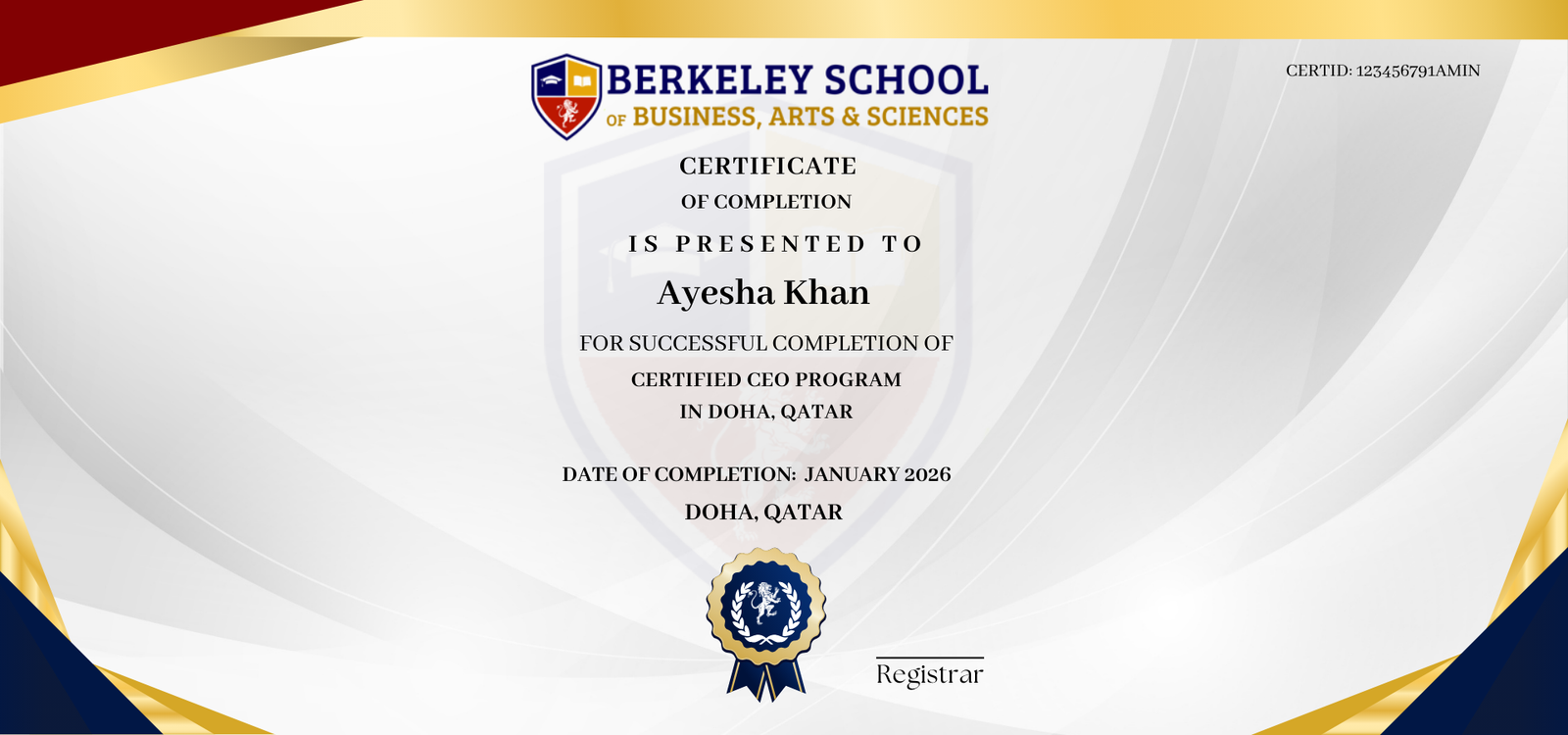
You will get a certificate of completion, which is highly reputed and accepted by employers.

Strategic Leadership

Enhance your ability to develop and execute strategic plans that drive organizational success.

Executive Decision-Making

Gain skills in making high-impact decisions and managing complex business challenges.

Organizational Management

Learn advanced techniques for managing and leading large teams and departments.

Financial Acumen

Develop a deep understanding of financial management and its role in driving organizational growth.

Change Management

Acquire strategies for leading and managing organizational change effectively.

Contact Us

Facebook Twitter Instagram Linkedin Youtube Tiktok
Cart

Cart (0)