BERKELEY SCHOOL OF BUSINESS, ARTS & SCIENCES

Anti Money Laundering Course in Lagos Nigeria (CAMS)

Certified Anti-Money Laundering Specialist certification equips professionals in Lagos, Nigeria with the expertise to detect, prevent, and report financial crimes. Recognized worldwide, it strengthens careers in compliance, banking, and risk management. This program enhances knowledge of AML regulations, due diligence, and investigative techniques, ensuring organizations meet global anti-money laundering standards effectively.

Anti Money Laundering Course in Lagos Nigeria (CAMS)

Overview

The Certified Anti-Money Laundering Specialist training is designed to provide professionals in Lagos, Nigeria with the expertise required to manage money laundering risks and comply with relevant regulations. It focuses on a comprehensive understanding of the principles, tools, and techniques used in detecting and preventing money laundering in a variety of industries, including banking, finance, insurance, and law enforcement. The CAMS certification is one of the most prestigious and globally recognized qualifications in the field of anti-money laundering (AML).

Offered by

ACAMS (Association of Certified Anti-Money Laundering Specialists)

Head office

Headquartered at 7300 N. Kendall Drive, Suite 500, Miami, FL 33156, USA.

Card image

Members

ACAMS has over 80,000 members worldwide, working across Lagos, Nigeria and more than 200 countries and territories in AML compliance and financial crime prevention.

Vision & Mission

ACAMS’ vision is to create a world where professionals can effectively combat financial crimes, ensuring a safer global financial system. Its mission is to empower members with the knowledge, training, and certifications needed to prevent money laundering and promote compliance, supporting efforts to protect financial integrity worldwide, including in Lagos, Nigeria.

What is the eligibility?

Professional Experience: At least 40 hours of AML-related work experience in the past 12 months, or an equivalent combination of education and professional experience in the AML field within Lagos, Nigeria.

Educational Background: While there is no strict educational requirement, having a background in law, finance, or business is helpful for AML professionals in Nigeria.

Who can do?

Card image

Anyone who is interested to learn about following concepts can pursue Certified Anti-Money Laundering Specialist training in Lagos, Nigeria:

Money Laundering Fundamentals, AML Regulatory Frameworks, Know Your Customer (KYC) and Customer Due Diligence (CDD), Suspicious Activity Reporting (SARs), Risk Management, Compliance Programs and Best Practices, Sanctions and Global Regulations, Investigations and Enforcement.

Individuals with the following designations:

Compliance Officers, Risk Managers, Auditors, Bankers and Financial Services Professionals, Law Enforcement and Regulatory Personnel, Legal Professionals, Consultants, Anyone Seeking to Transition into AML in Lagos, Nigeria.

Course structure

CAMS: Certified Anti-Money Laundering Specialist

The training covers several important topics that AML professionals in Lagos, Nigeria need to master, including:

  • ✔ Money Laundering Fundamentals
  • ✔ AML Regulatory Frameworks
  • ✔ Know Your Customer (KYC) and Customer Due Diligence (CDD)
  • ✔ Suspicious Activity Reporting (SARs)
  • ✔ Risk Management
  • ✔ Compliance Programs and Best Practices
  • ✔ Sanctions and Global Regulations
  • ✔ Investigations and Enforcement

Lecture Plan

Session 1: Introduction to Anti-Money Laundering (AML)

Learning Objectives: Understand what money laundering is and why it's critical to combat. Get familiar with key terminology, stages, and global laws in Lagos, Nigeria.

Overview of Money Laundering and its impact on the global financial system.
The Stages of Money Laundering: Placement, Layering, Integration.
Financial Crimes and Terrorist Financing.
Key AML terminology.
Introduction to Global Regulatory Frameworks: FATF, GAFI, and other authorities.

Session 2: Legal and Regulatory Framework for AML

Learning Objectives: Understand global AML standards and regulatory requirements. Learn the key laws that shape AML compliance across Nigeria and international jurisdictions.

International AML Standards (FATF recommendations, UN resolutions, etc.).
Major AML Laws and Regulations: USA PATRIOT Act, Bank Secrecy Act, EU Directives.
Key definitions: CDD, EDD, KYC, PEP (Politically Exposed Persons).
Sanctions and Embargoes: OFAC and EU sanctions list.

Session 3: The Role of Financial Institutions in AML Compliance

Learning Objectives: Learn how AML programs are structured within financial institutions. Understand compliance roles and strategies for monitoring AML risks in Lagos, Nigeria.

The AML Compliance Program in Financial Institutions.
Roles of AML Officers and the Compliance Team.
Risk-based approach: How to conduct risk assessments.
Internal controls and monitoring systems.
Employee training and fostering a compliance culture.

Session 4: Customer Due Diligence (CDD) and Know Your Customer (KYC)

Learning Objectives: Understand the different levels of customer due diligence. Learn the importance of assessing and verifying customer identities in AML frameworks.

What is Customer Due Diligence (CDD)?
Know Your Customer (KYC): Regulatory requirements and processes.
Risk-based CDD: Tailoring checks based on risk levels.
Understanding Politically Exposed Persons (PEPs).
How to manage Beneficial Ownership and Ultimate Beneficial Ownership (UBO).

Session 5: Detecting and Investigating Suspicious Activities

Learning Objectives: Learn how to identify suspicious transactions and how they are flagged. Understand the investigation and reporting process in AML environments in Lagos, Nigeria.

Identifying Red Flags in financial transactions
Use of Transaction Monitoring Systems (TMS) in detecting suspicious activity
Investigating Suspicious Activity and Transaction Analysis
Reporting obligations: Suspicious Activity Reports (SARs)

Session 6: International Cooperation in AML

Learning Objectives: Understand how international AML efforts align. Learn about the collaborative efforts in detecting and investigating money laundering across borders relevant to Nigeria and global frameworks.

The role of international cooperation in fighting money laundering
Global entities: FATF, Egmont Group, and international AML networks
Cross-border AML collaboration between regulators and financial institutions
Sharing information with law enforcement and global authorities

Session 7: Financial Crimes, Terrorist Financing & Sanctions Compliance

Learning Objectives: Understand how terrorist financing and money laundering are connected. Learn about the regulatory landscape surrounding sanctions and embargoes in AML compliance.

Understanding the link between money laundering and terrorist financing
The role of sanctions compliance in AML
International sanctions programs and regulations
Key compliance challenges in sanctions screening

Session 8: Anti-Money Laundering Technologies

Learning Objectives: Learn about the cutting-edge technologies used in detecting money laundering. Understand how AI and blockchain are revolutionizing AML compliance in Lagos, Nigeria.

Emerging AML technologies: Artificial Intelligence (AI), Machine Learning, Blockchain
The role of technology in detecting suspicious transactions
RegTech (Regulatory Technology) and its role in AML compliance
Future of AML technology and its impact on financial crime prevention

Session 9: Case Studies and Real-World Applications

Learning Objectives: Apply theoretical knowledge to real-life money laundering cases. Understand lessons learned from both successful and failed AML programs in Lagos, Nigeria and global financial institutions.

Real-world AML case studies: Understanding key cases (e.g., Danske Bank, Deutsche Bank)
Analyzing AML failures and successes
Key lessons from past money laundering investigations
Practical application: Designing an effective AML compliance program

Session 10: Exam Preparation and Review

Learning Objectives: Prepare effectively for the CAMS exam. Review key AML concepts and address any uncertainties for candidates in Lagos, Nigeria.

CAMS Exam Format and Structure
Review of Key Concepts from all modules
Tips and strategies for test-taking
Practice exam questions and discussion
Q&A session for any remaining questions

Learning Methodology

Berkeley offers expertly developed learning materials tailored to meet participants' needs in Lagos, Nigeria, ensuring comprehensive coverage of the CAMS syllabus and optimal AML exam preparation.

  • ► Tailored Material: Guides are designed to cover the entire syllabus, offering full preparation and deep understanding aligned with AML compliance standards.
  • ► In-Depth Content: Unlike superficial outlines, our materials provide fully developed theories and concepts, equipping participants with complete AML and financial crime knowledge.
  • ► Strategic Study: We help participants prioritize study time by indicating the weight of each topic, allowing efficient focus on crucial AML areas.
  • ► Difficulty Levels: Topics are labeled as "Awareness" or "Proficiency," guiding participants to allocate time based on the required depth of knowledge for CAMS certification success.
  • ► Comprehensive Coverage: Our materials include detailed theory and a glossary of technical terms to clarify complex AML compliance concepts.
  • ► Effective Learning Techniques: Visual aids and memorization techniques ensure long-lasting retention, helping candidates succeed in CAMS exams.

Berkeley’s methodologies equip participants with the essential knowledge and tools for both exams and future success in Anti Money Laundering roles across Lagos, Nigeria.

Lectures
Lectures
Practice Session
Practice Session
Mock Examination
Mock Examination

Berkeley's performance standards

Evaluates and ensures the quality of the AML training program in Lagos, Nigeria and all its deliverables. This is measured through the following indicators aligned with CAMS preparation standards:

  • ► Instructors’ experience and style in presenting and explaining AML compliance and financial crime prevention topics.
  • ► Variety and balance of teaching methods (such as discussions, case studies, mock exams, and videos) used in the course to ensure retention and to match the learning objectives in CAMS training.
  • ► Level of interactivity in AML learning sessions and engagement within Nigeria’s financial compliance environment.
  • ► Feedback from program participants enrolled in Anti Money Laundering training in Lagos, Nigeria.
  • ► Full compliance with institute standards and guidelines for AML preparation, study requirements, and professional methodology.
  • ► Progress reports from the AML training program provider supporting CAMS certification success.

What are the Exam Information?

Exam format & duration

* CBT (Computer Based Testing) for CAMS certification in Lagos, Nigeria

Part/Module Exam format Exam duration
CAMS: Certified Anti-Money Laundering Specialist The exam consists of 120 multiple-choice questions focused on AML compliance, financial crime prevention, and regulatory frameworks. 3.5 hours

Exam Dates

The CAMS exam is offered year-round in Lagos, Nigeria, allowing candidates to choose a convenient date and time for AML certification preparation.

Card image

Passing Criteria

The passing score for the CAMS (Certified Anti-Money Laundering Specialist) exam in Lagos, Nigeria is typically 75% or higher, ensuring strong competency in AML compliance and financial crime prevention.

Exam Locations

CAMS exams are administered through the worldwide network of Pearson VUE testing centers, including access for candidates in Lagos, Nigeria. Pearson VUE provides flexible options for candidates to take the exam at physical testing centers or remotely through OnVUE, its secure online proctoring solution.

Success Stories

Success Stories

“As a strong advocate for education and human development, I commend Berkeley for its exceptional commitment to empowering future leaders in Lagos, Nigeria. The institution stands as a symbol of excellence, innovation, and opportunity. Students who walk its halls are nurtured with knowledge, values, and vision—qualities that contribute to building a stronger and more prosperous future for our nation.” – H.H. Shaikh Khalifa Al Hamid

Visit Our Alumni

Alumni Benefits

  • ► Exclusive Networking Events: Access invitations to industry-leading AML and financial crime events in Lagos, Nigeria and thought-leadership gatherings featuring renowned compliance experts.
  • ► Monthly Updates: Stay informed with a newsletter highlighting the latest AML research, regulatory developments, events, and activities relevant to Nigeria’s financial sector.
  • ► LinkedIn Community Access: Join the Executive Education LinkedIn group for networking, AML career growth, and professional development opportunities.
  • ► Educational Discounts: Enjoy a 20% discount on open-enrollment programs and access to workshops focused on emerging AML trends and compliance frameworks.
  • ► Global Alumni Network: Connect with a diverse alumni community through Berkeley School’s online network and engage in country and AML interest groups.

Is It Worth the Investment?

AML Compliance Officers: Average Salary: $60,000 - $90,000 per year in Lagos, Nigeria. Senior-Level Salary: In managerial or director roles, the salary can range from $100,000 - $130,000 per year within the financial crime compliance sector.

AML Managers/AML Compliance Managers: Average Salary: $85,000 - $115,000 per year. Senior-Level Salary: Senior AML Managers, or those heading compliance departments, can earn $120,000 - $150,000 or more, depending on their experience and location in Nigeria.

AML Risk Managers: Average Salary: $80,000 - $120,000 per year. Senior-Level Salary: Senior AML Risk Managers can earn upwards of $130,000 - $160,000+ annually, especially in large financial institutions in Lagos, Nigeria.

AML Investigators: Average Salary: $60,000 - $90,000 per year. Senior Investigator/Analyst: Experienced investigators in senior roles can earn between $95,000 - $120,000 within Nigeria’s AML compliance environment.

Compliance Directors/Head of AML: Average Salary: $120,000 - $180,000 per year. For more experienced professionals or those at large organizations in Lagos, Nigeria, salaries can exceed $200,000 annually.

Card image

AML Consultants: Average Salary: $90,000 - $150,000 per year in Lagos, Nigeria (depending on whether they work for a consulting firm or independently). Consultants who specialize in high-demand sectors or have significant experience can earn $160,000 - $250,000+.

Financial Crimes Enforcement & Investigation Roles: Average Salary: $75,000 - $110,000 per year. Senior Law Enforcement Professionals: Senior roles such as AML investigators at enforcement agencies can have salaries ranging from $120,000 to $150,000 per year within Nigeria’s financial crime sector.

What you earn

What you earn

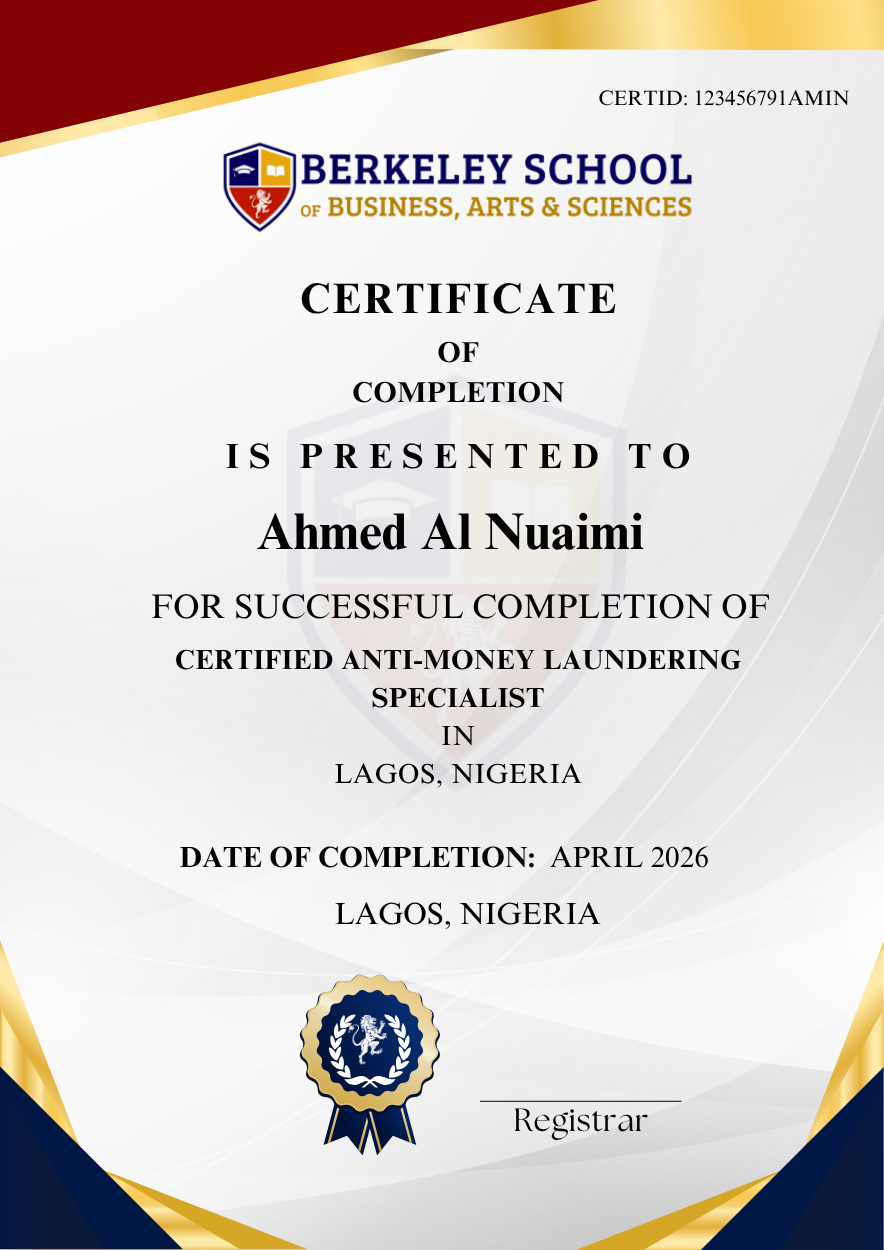
You will get a certificate of completion, which is highly reputed and accepted by employers in Lagos, Nigeria and across the global AML and financial crime compliance industry.

Increased Job Opportunities

The CAMS certification opens up opportunities for higher-level positions in compliance, risk management, and financial crime prevention across industries in Lagos, Nigeria and internationally.

Global Recognition

AML is a global issue, and the demand for compliance professionals is not limited to one region or country, including strong demand within Nigeria’s financial sector.

Career Advancement

Holding a CAMS certification positions you as an expert in the field of AML, often leading to faster career advancement. Professionals with CAMS are often considered for higher-level roles such as AML Manager, Compliance Director, Risk Officer, or Head of Compliance in Lagos, Nigeria and global financial institutions.

Related courses

FRM - Financial Risk Manager

The Financial Risk Manager (FRM) certification is a globally recognized credential awarded by GARP, designed for professionals in risk management, finance, and investment sectors, focusing on assessing, managing, and mitigating financial risks.

Read More

CISA - Certified Information Systems Auditor

CISA qualification is awarded by ISACA and is globally recognized for professionals in information systems auditing, control, and security, ensuring expertise in governance, compliance, and IT risk management.

Read More

CISSP - Certified Information Systems Security Professional

The CISSP certification is a globally recognized credential in cybersecurity, validating expertise in security architecture, risk management, and protection of information systems across organizations.

Read More

FAQ: Certified Anti-Money Laundering Specialist

What is CAMS certification?
CAMS is a globally recognized certification for professionals in anti-money laundering (AML). It demonstrates expertise in identifying, preventing, and reporting financial crime activities, along with understanding key regulations and compliance strategies in Lagos, Nigeria and globally.
Who is eligible to take the CAMS exam?
To be eligible, candidates must have at least 40 hours of AML training and at least 1 year of professional experience in the AML field. However, individuals without direct experience may also qualify by meeting specific training requirements.
What is the CAMS exam format?
The CAMS exam consists of 120 multiple-choice questions, covering topics related to AML regulations, financial crimes, risk management, customer due diligence, and investigation techniques. The exam lasts for 3.5 hours.
What is the CAMS exam format?
The CAMS exam consists of 120 multiple-choice questions, covering topics related to AML regulations, financial crimes, risk management, customer due diligence, and investigation techniques. The exam lasts for 3.5 hours.
What topics are covered in the CAMS exam?
The exam covers:
  • Introduction to money laundering and financial crime
  • AML laws and regulations
  • Customer Due Diligence (CDD) and Know Your Customer (KYC) requirements
  • Detection of suspicious activities and reporting obligations
  • The role of financial institutions in AML compliance
How long is the CAMS certification valid?
The CAMS certification is valid for three years. To maintain your certification, you must earn continuing education credits (CPEs) and renew your certification every three years.
What are the career benefits of obtaining the CAMS certification?
Obtaining CAMS opens up a wide range of career opportunities in AML compliance, risk management, and financial crime prevention. It can help professionals advance to senior positions, improve salary prospects, and gain recognition in the global financial industry, including in Lagos, Nigeria.
What is the pass rate for the CAMS exam?
The pass rate for the CAMS exam typically hovers around 60-70%, though it varies from year to year. Thorough preparation and a solid understanding of AML principles can significantly improve your chances of passing.
How long does it take to study for the CAMS exam?
On average, candidates spend 2-3 months preparing for the CAMS exam, depending on prior knowledge of AML and the time they can dedicate to study.
Can I retake the CAMS exam if I fail?
Yes, candidates can retake the CAMS exam if they fail. You must wait a minimum of 30 days after the first attempt to schedule a retake, and there may be an additional fee.
What is the passing score for the CAMS exam?
To pass the CAMS exam, you must achieve a 75% score or higher on the exam.
Can I take the CAMS exam online?
Yes, the CAMS exam can be taken online with an online proctoring service. This allows you to take the exam from home or another secure location in Lagos, Nigeria.

Contact Us

Facebook Twitter Instagram Linkedin Youtube Tiktok
Cart

Cart (0)